
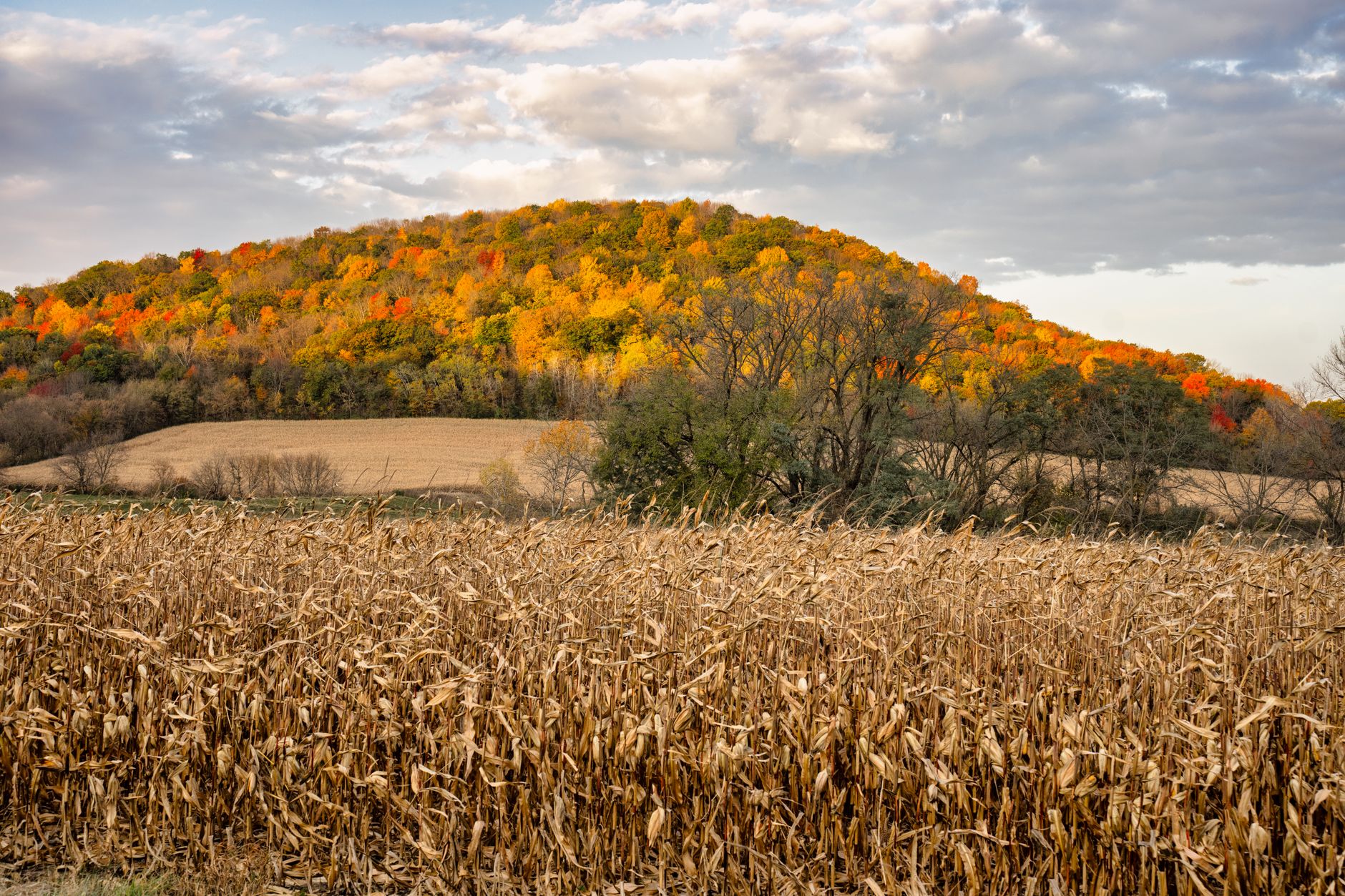
There is no single Wisconsin land market, and that is the first thing to understand if you plan to sell land by owner in Wisconsin. The state holds at least four distinct markets inside its borders: the dairy-intensive farmland of the southeast, where herd expansion and nutrient-management logistics are setting prices; the Driftless region's rolling, unglaciated cropland in the southwest; the irrigated vegetable ground of the Central Sands; and the north woods, where hunting leases and cabin buyers — not crops — drive demand.
Each of those markets sells very differently. The buyer pool, the pricing logic, the marketing channels, and the realistic time on market all change once you cross a regional line. A 40-acre tract in Kewaunee County and a 40-acre tract in Vilas County are both "Wisconsin land," and they may differ in value by a factor of four.
What does not change is the legal machinery. Every Wisconsin sale runs through the same Chapter 709 disclosure framework, the same $0.30-per-$100 real estate transfer fee, and the same county Register of Deeds recording process. Get those right, price the parcel to its actual sub-market, and the rest is a matter of reaching the right buyer. Every dollar figure in this guide is a directional, illustrative reference drawn from public and regional sources — not an appraisal of your parcel.
Wisconsin Farmland Near Dairies Is Up 25–35% in a Year
Farmland near southeastern Wisconsin's largest dairy operations has risen 25% to 35% over the past year, trading between $13,000 and $16,000 per acre — and the driver is not commodity prices. It is "manure access": dairies that have expanded from roughly 1,500 to more than 3,000 cows need cropland within a few miles of their barns to spread manure under nutrient-management rules, and they are paying well above what row-crop economics alone would justify.
AgCountry Farm Credit Services' July 2026 benchmark report shows Wisconsin's benchmark farmland values up 31.5% year over year — the sharpest of the three states AgCountry tracks. That benchmark is a small sample, so treat it as directional rather than a precise statewide average.
Read the full breakdown: Manure, Not Multiples: Why Land Near Wisconsin's Dairies Is Fetching $13,000 to $16,000 an Acre →
Realtor vs. FSBO vs. Cash Buyer (PlaceAcre)
Illustrated on a sample 40-acre Wisconsin parcel valued at $300,000 — $7,500 per acre, near the statewide average. Every net-proceeds figure below is an illustrative estimate, not a guarantee. Actual cash offers vary by parcel condition, access, soil, and location.
| Realtor (MLS) | FSBO | Cash Buyer (PlaceAcre) | |
|---|---|---|---|
| Commission | ~6% ($18,000) | $0 | $0 |
| Time to close | 90–180 days | 60–150 days | 7–30 days |
| Net proceeds (illustrative) | ~$282,000 minus closing costs | ~$300,000 minus marketing and closing costs | ~$255,000–$270,000 offer, no fees or repairs |
Figures are illustrative estimates on a hypothetical parcel, not guarantees or quoted offers. The transfer fee, title work, and recording costs apply on every path.
The 4-Step FSBO Roadmap for Wisconsin Land
Step 1 — Price
Wisconsin's per-acre range is wide enough that a statewide number is close to useless for pricing a single parcel. Raw north-woods recreational land runs roughly $3,200 to $4,500 per acre. Driftless-region ground generally trades at $7,500 to $11,000 per acre, with prime tillable reaching $12,500 to $16,000+. Cropland near southeast Wisconsin's dairy operations has been changing hands at $13,000 to $16,000 per acre. Your comparable-sales research has to be hyper-local — same county, similar soil, similar access, ideally within the last 18 to 24 months.
Start free with county assessor and land information office data. The Dane County Land Information Office and the Sauk County Land Information Office both publish parcel records, assessed values, and GIS layers you can search yourself. Every Wisconsin county maintains an equivalent office, and most now offer online parcel viewers with recent sale history attached.
Then layer in the UW-Extension county land-sale reports, which summarize agricultural land transfers by county and use class. Those reports separate ag-to-ag sales from ag-to-other sales, which matters enormously: a tract sold to a developer or a hobby buyer will not tell you what a neighboring dairy would pay for the same ground. Adjust for tillable percentage, drainage, road frontage, and — in the southeast — distance to the nearest large dairy operation.
Step 2 — Documents
Wisconsin requires a Real Estate Condition Report for residential parcels and a Vacant Land Disclosure Report under Wis. Stat. § 709.033 for raw land. FSBO sellers are not exempt from Chapter 709 disclosure duties — the obligation attaches to the seller, not to the presence of an agent. This is the single most common misunderstanding among Wisconsin owners selling on their own.
The vacant land report covers what a land buyer actually needs to know: known flooding or drainage problems, wetlands, whether the parcel can support a well and septic system, legal access, recorded easements, boundary disputes, contamination or buried fill, zoning and use restrictions, and any special assessments. Answer from your actual knowledge and keep a signed copy.
Alongside the disclosure, pull together the current deed with full legal description, your most recent property tax bill, and any existing survey or certified survey map. Order a title search before you list rather than after you have an offer — a rural Wisconsin title report is where unreleased mortgages, old utility easements, and unrecorded access arrangements surface, and every one of those is cheaper to clear on your own schedule than under a contingency clock.
Step 3 — Market
The highest-leverage FSBO move in Wisconsin is a flat-fee MLS listing. For a few hundred dollars a broker will place your parcel in the regional MLS while you keep the sale and the negotiation in your own hands. You avoid the listing-side commission but still appear in the database that agents and serious buyers search first.
Pair that with the land-specific marketplaces — Land.com, LandWatch, and the ag-focused listing sites. These matter for Wisconsin because your buyer often is not local. North-woods recreational tracts draw buyers from Illinois and the Twin Cities; Driftless cropland draws investors from outside the state entirely.
Do not skip the local channels. County-level Facebook land and hunting groups are unusually active in Wisconsin, and county extension office bulletin boards reach the agricultural buyers who often pay the most for tillable ground. In dairy country especially, the neighboring operator who can fold your acres into an existing nutrient-management plan is frequently the highest bidder and the simplest closing you will ever have.
Step 4 — Close
Wisconsin does not require an attorney at closing. Most sales run through a licensed title company that handles the search, the closing statement, the transfer fee, and recording. An attorney is optional and worth the money on estates, land contracts, seller financing, or boundary questions.
Budget for these fee ranges: title search and exam roughly $300 to $600; owner's title insurance around 0.5% to 1% of the sale price; and the Wisconsin real estate transfer fee at $0.30 per $100 of value, customarily seller-paid but negotiable, filed with the county Register of Deeds. On the $300,000 example, the transfer fee is $900.
The deed and the transfer return go to the county Register of Deeds for recording, typically at $30 to $50 per document. A clean cash closing on Wisconsin land commonly runs 7 to 21 days once title comes back clear; a financed purchase on rural acreage usually stretches to 45 days or more while the lender orders an appraisal.
FSBO in Wisconsin: Advantages vs. Challenges
Advantages
- Keep the full sale price minus your own costs. No listing commission comes off the top. On a $300,000 parcel that is $18,000 that stays with you, against a few hundred to a couple thousand in self-funded marketing.
- Control the timeline. You decide when to list, whether to wait out a neighboring dairy's offer, and whether to close before or after the crop year, hunting season, or a tax deadline.
- Direct buyer relationships. You answer questions about tillable acres, drainage, access, and nutrient-management history yourself. On Wisconsin ag ground, where the details are the deal, that usually produces a cleaner and faster negotiation than messages relayed through two brokers.
Challenges
- Chapter 709 duties apply the same as an agent-assisted sale. The Vacant Land Disclosure Report and the 10-day delivery window are your responsibility, and getting them wrong creates real liability.
- Narrower marketing reach without MLS syndication. Unless you buy a flat-fee listing, your parcel never reaches the database most buyers and every agent searches first.
- Valuation is genuinely hard across Wisconsin's regional markets. Dairy country, the Driftless, the Central Sands, and the north woods price on completely different logic, and without agent comps access it is easy to be 30% off in either direction.
- Carrying costs while you wait. Property taxes, insurance, and any weed or fence obligations keep running through a 60- to 150-day FSBO timeline.
What the Commission Actually Costs You
Run the arithmetic on a $300,000, 40-acre Driftless-region parcel. A typical 6% listing commission works out to $300,000 × 0.06 = $18,000, usually split between the listing and buyer's brokerages. That is $282,000 to you instead of $300,000, before the transfer fee, title work, and recording costs — which you owe on every path.
Selling FSBO or directly to a cash buyer keeps that $18,000. Against it, budget your own out-of-pocket costs: $150 to $600 for a flat-fee MLS placement, $200 to $500 for drone photography, $100 to $300 for plat maps and printing, and any buyer concessions you negotiate in place of a commission. Call it $500 to $1,500 in hard marketing costs, plus whatever a buyer extracts at the table knowing no agent is involved.
That does not make an agent the wrong choice in every case. A broker with a standing buyer list for Driftless tillable ground or dairy-adjacent cropland can sometimes produce a gross price that beats what you would reach alone by more than the fee — that is the honest test. On a clean parcel with obvious access and an interested neighboring operator, the premium usually does not materialize. On a complex tract in a thin market, it often does.
The Tactical Version: 5 More Steps
5. Get an appraisal or a broker price opinion
A rural acreage appraisal in Wisconsin typically runs $400 to $900, with larger, unusual, or multi-parcel properties costing more — treat that as an illustrative range, not a quote. A broker price opinion is cheaper and faster and is often enough for a straightforward tract. The real value is not the number; it is having something independent and defensible when a buyer challenges your price. Estate parcels, properties being divided among heirs, and any sale that may be scrutinized for tax purposes justify the full appraisal.
6. Build the marketing packet before you list
Drone photographs and a video pass. A plat map with boundaries drawn over county GIS aerial imagery. A link to the parcel's soil survey from the NRCS Web Soil Survey. And, critically for Wisconsin, an explicit acreage breakdown: tillable acres, pasture, timber, wetland, and any CRP or conservation enrollment. Add road frontage, water features, and utility availability. A packet that answers the obvious questions up front produces fewer calls and much better ones.
7. Negotiate differently with ag buyers than with recreational buyers
An agricultural buyer is running a spreadsheet: yield history, soil productivity index, drainage, field shape, distance from their existing operation, and — in the southeast — whether the acres fit their nutrient-management plan. Bring data and expect a disciplined, unsentimental offer that often closes fast. A recreational or hunting buyer is buying an experience: cover, water, deer sign, cabin sites, seclusion, and legal access. They pay more for atmosphere and less for tillable percentage, but they are more likely to need financing and more likely to walk during due diligence. Price and pitch the same parcel differently depending on which buyer you are talking to.
8. Handle multiple-heir or estate-owned parcels early
A large share of Wisconsin land sales involve inherited ground with several owners on the deed. Before you market anything, confirm who actually holds title — every heir, every spouse with a marital-property interest under Wisconsin law, and whether probate has closed. All titleholders must sign the deed. Decide in advance who is authorized to negotiate, get that in writing, and if the estate is still open, talk to the personal representative and a probate attorney before you accept an offer. Deals collapse at the closing table over a missing signature far more often than over price.
9. Schedule the closing with a title company
Open with the title company as soon as the offer is accepted and hand over everything at once: the deed, legal description, payoff information for any mortgage or lien, your completed Vacant Land Disclosure Report, and any survey. The title company will run the search, prepare the closing statement, calculate the $0.30-per-$100 transfer fee, and file the deed and electronic transfer return with the county Register of Deeds. Ask for a preliminary settlement statement several days ahead so nothing about your net proceeds is a surprise.
Wisconsin Legal Requirements and Closing Costs
Two requirements do most of the work in a Wisconsin land sale: the Chapter 709 disclosure and the state transfer fee. Understand both before you list rather than at the closing table.
Chapter 709 Disclosure — Wis. Stat. § 709.033
Wisconsin Statute Chapter 709 governs seller disclosure. Residential parcels use the Real Estate Condition Report; raw acreage uses the Vacant Land Disclosure Report under § 709.033. Under § 709.03, the completed report must be delivered to the buyer within 10 days of accepting an offer. Selling without an agent does not exempt you. The report asks about known conditions — flooding, wetlands, well and septic feasibility, access, easements, boundary disputes, contamination, zoning limits, and special assessments — and you answer from your actual knowledge.
Real Estate Transfer Fee and Closing Costs
The Wisconsin Real Estate Transfer Fee is $0.30 per $100 of value (0.3% of the sale price), customarily paid by the seller but negotiable, and filed with the county Register of Deeds along with the electronic real estate transfer return. Typical seller-side costs on a land sale:
| Cost | Typical range | On a $300,000 sale |
|---|---|---|
| Real estate transfer fee | $0.30 per $100 of value | ~$900 |
| Title search and exam | $300–$600 | $300–$600 |
| Owner's title insurance | ~0.5%–1% of price | ~$1,500–$3,000 |
| Recording fees | $30–$50 per document | $30–$100 |
This section is general information, not legal or tax advice. Confirm current requirements and fees with the Wisconsin Department of Revenue, your county Register of Deeds, or a Wisconsin attorney.
Wisconsin Land Values by Region
A statewide average tells you almost nothing about a specific Wisconsin parcel. These four sub-regions behave like four separate markets, with different buyers, different price drivers, and different realistic timelines.
Southeast Wisconsin — Dairy Country
$13,000–$16,000/acreCropland near large dairy operations commands the steepest premiums in the state. Demand here is driven by nutrient-management and manure-hauling logistics rather than crop prices alone: dairies that have grown past 3,000 cows need spreadable acres within a short haul of their lagoons, and commercial waste processors seeking land-application sites have entered the same local markets. If your ground sits within a few miles of a large operation, that proximity may be worth more than the soil itself.
Driftless Region — Southwest Wisconsin
$7,500–$11,000/acreThe unglaciated Driftless region trades generally in the $7,500 to $11,000 range, with prime tillable ground reaching $12,500 to $16,000 or more per acre. Demand here is driven by soil productivity and the region's long-standing reputation among row-crop buyers. Topography matters enormously: a ridge-top field and a steep hillside in the same 40 acres can differ by a factor of three in per-acre value, so break out your tillable acres explicitly.
Central Sands — Central Wisconsin
Sharp multi-year run-upIrrigated vegetable and potato ground in the Central Sands has appreciated sharply. Regional land-brokerage reporting suggests that six years ago roughly $100,000 bought about 40 acres in this market; today that same money typically buys 10 to 25 acres — a substantial multi-year price run-up. Treat that comparison as illustrative and sourced to regional brokerage commentary rather than a single published dataset. Irrigation infrastructure and high-capacity well permitting are central to value here.
Northern Wisconsin — North Woods
$3,200–$4,500/acreRaw recreational and hunting land in the north woods runs roughly $3,200 to $4,500 per acre. Demand comes from hunting-lease holders and cabin buyers rather than agricultural operators, and buyers price cover, water, deer and grouse habitat, seclusion, and legal year-round access far above tillable percentage. Timber value can be a meaningful component; a current timber cruise is worth having before you set a price.
All regional per-acre figures are directional and illustrative, drawn from AgCountry Farm Credit Services, Compeer Financial reporting, and regional land-brokerage commentary. They are not appraisals and should not be applied to a specific parcel without local comparable sales. For the dairy-country figures, see our companion report on the manure-access premium.
Photography and Listing Presentation
Fly it, and show the split. The single most useful drone shot on a Wisconsin parcel is the one that makes the tillable-versus-wooded division obvious from the air. Buyers are trying to work out how many workable acres they are actually getting; a pass at 200 to 300 feet answers in two seconds what three paragraphs of description cannot. Capture water features — creeks, ponds, springs, wetland edges — and shoot the road frontage from both directions so access is unambiguous.
Include a plat map and a soil-productivity rating. The NRCS Web Soil Survey is free and produces a parcel-specific soil map and productivity index that ag buyers in the Driftless and the southeast will look up anyway. Publishing it yourself signals you know what you are selling and shortens the diligence conversation considerably.
State the acreage breakdown explicitly. Wisconsin buyers usually want one specific land type — tillable, pasture, or timber — and a listing that says "40 acres" without the split gets skipped. Write it out: tillable acres, pasture, timber, wetland, CRP enrollment, road frontage, and utility availability. Shoot in the hour after sunrise or before sunset, and if the parcel is in the north woods, include at least one fall-color and one bare-tree frame so hunting buyers can read the cover honestly.
Skip the Hassle — Get a Cash Offer in 24 Hours
If speed and certainty matter more to you than squeezing out the last dollar, a direct cash sale on Wisconsin land closes in as little as 7 to 30 days, with no commissions and no fees. It is one option among several — worth comparing honestly against a flat-fee MLS listing or a full-service broker before you commit either way.
Get My Cash OfferFrequently Asked Questions
Do I have to disclose known defects when selling Wisconsin land by owner?
Yes. Wisconsin Statute Chapter 709 requires a completed disclosure report — a Vacant Land Disclosure Report under § 709.033 for raw acreage — delivered to the buyer within 10 days of accepting an offer under § 709.03. This duty applies whether or not you use a real estate agent. Selling FSBO does not exempt you from Chapter 709. The report asks about known conditions such as flooding, wetlands, septic and well feasibility, boundary or access disputes, easements, contamination, zoning restrictions, and any structures or fill on the property. Answer from your actual knowledge, in writing. You are not required to inspect or investigate conditions you do not know about, but you cannot conceal defects you do know about.
Do I need a real estate attorney to close a Wisconsin land sale?
No. Wisconsin does not require an attorney at closing, and most land sales in the state close through a licensed title company that handles the title search, prepares the closing statement, collects the transfer fee, and records the deed with the county Register of Deeds. Hiring an attorney is optional — figure roughly $252 per hour, or a flat fee in the $750 to $1,250 range for a straightforward closing, as illustrative market rates. An attorney earns their fee on complicated transactions: estate or multiple-heir parcels, seller financing, land contracts, boundary or easement disputes, and splits that need a certified survey map.
How much is Wisconsin land worth per acre?
It varies dramatically by region, and a statewide average will mislead you. Raw recreational and hunting land in the northern Wisconsin north woods typically runs roughly $3,200 to $4,500 per acre. The Driftless region of southwest Wisconsin generally trades in the $7,500 to $11,000 per acre range, with prime tillable ground reaching $12,500 to $16,000 or more. Farmland near southeast Wisconsin's large dairy operations has been trading at $13,000 to $16,000 per acre in 2026 on nutrient-management demand. These are directional, illustrative ranges drawn from regional reporting, not appraisals of any specific parcel.
How fast can I sell my Wisconsin land without a realtor?
FSBO timelines in Wisconsin typically run 60 to 150 days depending on price, region, and how well the parcel is documented. Dairy-country cropland with an interested neighboring operator can move much faster; remote north-woods recreational acreage priced above the market can sit for a year. A direct cash offer can close in as little as 7 to 30 days because it skips the financing contingency, the lender appraisal, and the marketing window entirely — you are trading some price for speed and certainty, which is worth comparing honestly against a listing before you decide.
Related Resources
Related Locations in Wisconsin
Wisconsin county-level pages are still in progress — check back as they launch. In the meantime, the state hub covers all 72 counties.