
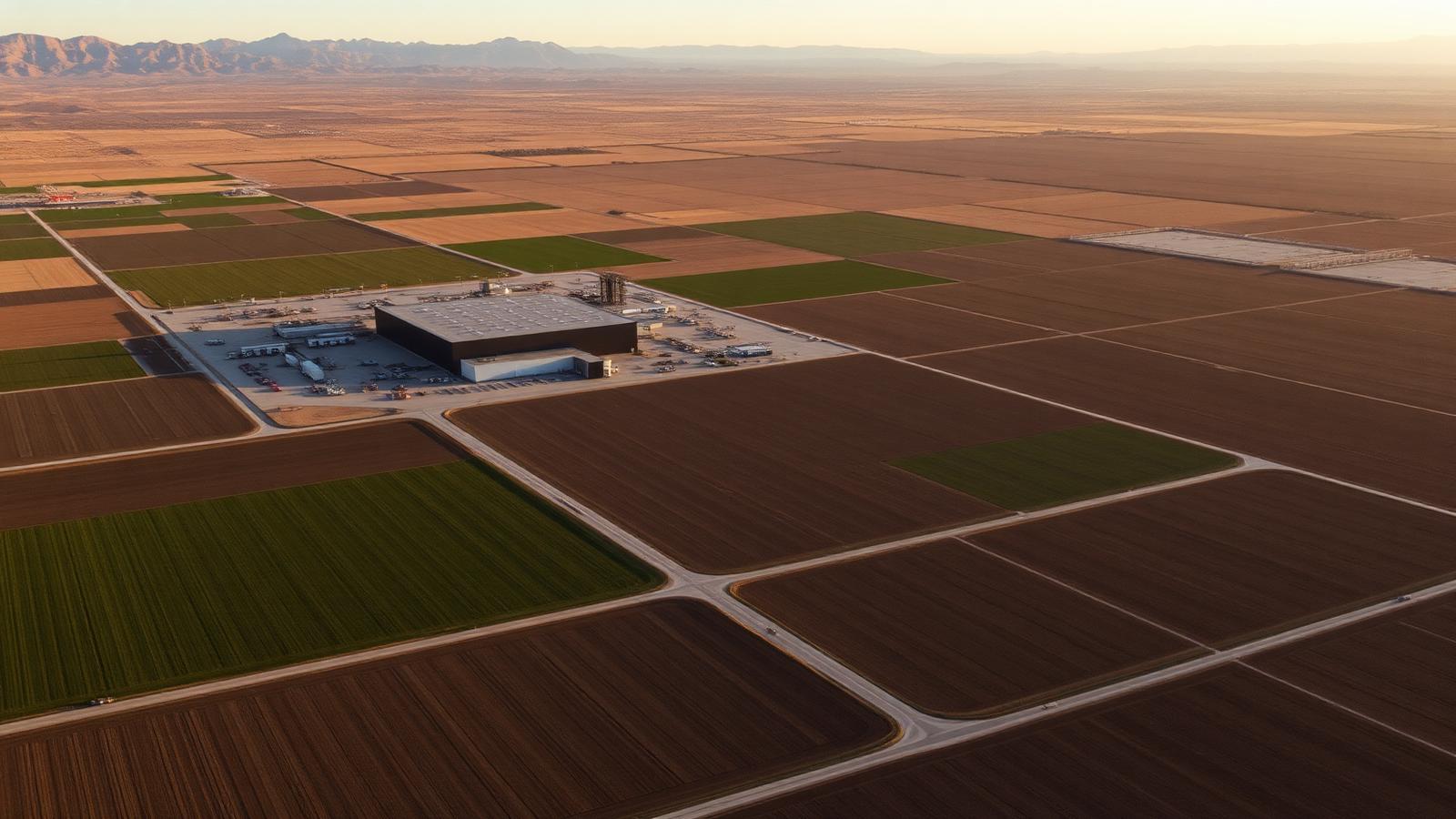
In April 2026, Imperial County supervisors cleared the way for what would be California's largest data center — a nearly 1-million-square-foot AI/machine-learning facility proposed for farmland outside El Centro — by approving a land-tract merger without a full environmental review. By mid-June, after months of public backlash, the same five-member board reversed itself, voting unanimously to impose a 45-day moratorium on new data center approvals and create a public commission to study zoning policy for the industry.
2026 Update — Developing Story
- April 2026: Imperial County Board of Supervisors approves combining several tracts of farmland for the ~950,000–1,000,000 sq. ft. "Imperial Data Center," developed by Imperial Valley Computer Manufacturing, LLC (principal: Sebastian Rucci). The merger and an earlier grading permit are approved as routine "ministerial" actions under existing industrial zoning, without the extensive CEQA environmental review normally required for a project of this scale.
- April 2026: The developer states the project will bring 2,500 construction jobs, 100 permanent jobs, a one-time $72.5 million sales-tax payment, and $28.7 million in annual tax revenue. These are developer-provided figures — no independent audit or public filing confirms them as of this writing.
- June 15, 2026: The developer sues the Imperial Irrigation District in Imperial County Superior Court, seeking roughly 260 million gallons of Colorado River water per year. The suit proposes fallowing 160 acres of adjacent farmland the company purchased and transferring that parcel's existing water right to the data center instead.
- June 16–17, 2026: Facing months of backlash and an hours-long public hearing, the Board of Supervisors votes 5-0 to impose a 45-day moratorium on new data center approvals and forms a zoning advisory commission tasked with recommending policy. The moratorium is on track to lapse in early August 2026 absent further board action.
- June 23, 2026: Developer Sebastian Rucci says he is filing suit for a temporary restraining order against the moratorium, arguing the county failed to demonstrate a genuine emergency. No public court ruling on the TRO request had been reported as of this writing — flagged here as unresolved/unconfirmed.
- Ongoing: The City of Imperial has filed a separate CEQA lawsuit arguing the project, sited a few hundred feet from homes, was wrongly approved as exempt from environmental review. A local ballot-referendum campaign is also collecting signatures to ban data centers countywide.
Imperial County Timeline at a Glance
| Milestone | Status | Notable development |
|---|---|---|
| April 2026 | Land-tract merger + grading permit approved (ministerial, no full CEQA review) | Clears way for CA's largest data center |
| June 15, 2026 | IID water lawsuit filed | Developer seeks 260M gal/year Colorado River water via 160-acre farmland fallowing |
| June 16–17, 2026 | 45-day moratorium + zoning commission approved (5-0) | Halts new data center approvals countywide |
| June 23, 2026 | Developer TRO lawsuit against moratorium announced | No public ruling confirmed as of this writing |
| Ongoing | City of Imperial CEQA lawsuit + citizen referendum drive | Outcome pending |
From Farmland to Hyperscale, Almost Overnight
The Imperial Data Center didn't arrive through a rezoning fight. It arrived through paperwork. In April 2026, the Board of Supervisors approved a merger of several adjacent farmland parcels outside El Centro as a ministerial action — a category of approval that, under California land-use law, is treated as routine and largely non-discretionary. Because the underlying parcels already sat under industrial zoning, staff processed the merger and an earlier grading permit without triggering the full California Environmental Quality Act (CEQA) review normally applied to a project approaching one million square feet.
That decision became the flashpoint. Neighbors, farmers, and the nearby City of Imperial argued that a project of this scale — sited a few hundred feet from homes — should never have qualified for a CEQA exemption. If you own land in the county and want to see what it could be worth today, get a fair cash offer for your Imperial County land.
The Water Question
Imperial County runs almost entirely on Colorado River water, delivered by the Imperial Irrigation District (IID) under some of the most senior water rights in the Western United States. Those rights are precisely why the Imperial Valley is one of California's most productive winter-vegetable regions — lettuce, broccoli, carrots, and alfalfa move from these fields to grocery shelves across the country each winter.
On June 15, 2026, the developer sued IID seeking roughly 260 million gallons of water per year for the data center. The mechanism proposed in the suit is a swap: fallow 160 acres of adjacent farmland the company already purchased, and transfer that parcel's existing agricultural water right to the data center instead. The suit lands at a moment when the Colorado River basin is already operating under multi-state shortage-sharing agreements, making any new industrial diversion politically and legally freighted.
Backlash and the Moratorium
By early summer, the April approval had drawn organized opposition from residents, farmers, and the City of Imperial. At an hours-long public hearing on June 16–17, 2026, the same Board of Supervisors that had waved the merger through in April voted 5-0 to impose a 45-day moratorium on any new data center approvals countywide. In the same motion, the board created a zoning advisory commission — with seats reserved for members of the public, not just supervisors — tasked with recommending how the county should treat future data center proposals.
The moratorium is on track to lapse in early August 2026 absent further action. The commission's recommendations are the mechanism most likely to convert the pause into durable policy.
"We're losing our ability to compete because of California-specific rules and regulations. I want clean air, I want clean water — but economics come to the forefront."
Sacramento Gets Involved
State Sen. Steve Padilla (D–San Diego), whose district includes Imperial County, has introduced multiple bills responding to the fight. SB 675 restructures the county's air pollution control board to add non-supervisor members, diluting the concentration of land-use authority in a single elected body. SB 886 would require data centers to pay upfront energy infrastructure costs rather than shifting them to other ratepayers on the grid.
Both bills had passed the state Senate and were awaiting Assembly votes as of late June 2026. Their fate will materially affect whether Imperial County's fight becomes a template for other California counties — or a one-off resolved locally.
A Statewide Pattern
Imperial County isn't alone. In June 2026, Monterey Park (Los Angeles County) became the first California city to pass an outright data center moratorium. Similar community fights are playing out in Central Valley and Inland Empire jurisdictions where cheap flat land, existing industrial zoning, and proximity to fiber corridors have made agricultural parcels suddenly attractive to hyperscale developers.
For a broader view of how California landowners are navigating this moment, see our full guide: How to Sell Land for Cash in California.
What Happens Next
- The 45-day moratorium is on track to lapse in early August 2026 unless the board extends it or codifies new zoning rules first.
- The zoning advisory commission's recommendations will shape whether the pause becomes durable policy or a footnote.
- The outcome of the developer's TRO request against the moratorium — still unconfirmed publicly as of this writing — could accelerate or moot the local process.
- The City of Imperial's CEQA lawsuit is a parallel track that could unwind the April approval on environmental-review grounds.
- The countywide citizen referendum signature drive, if it qualifies for the ballot, would let voters — not supervisors — set the ceiling on data center development.
Own farmland or vacant acreage near a data-center corridor?
Skip the uncertainty — get a no-obligation cash offer in 24 hours.
Sources & Further Reading
- CalMatters — "This million-square-foot data center would be the biggest in the state. How local leaders are challenging it," Deborah Brennan (June 23, 2026)
- KPBS — "After months of public pressure, Imperial County passes temporary moratorium on data centers" (June 17, 2026)
- inewsource — "Data center race officially on pause in Imperial County" (June 16, 2026)
- KPBS — "Imperial Valley data center developer files lawsuit seeking access to Colorado River water" (June 15, 2026)