
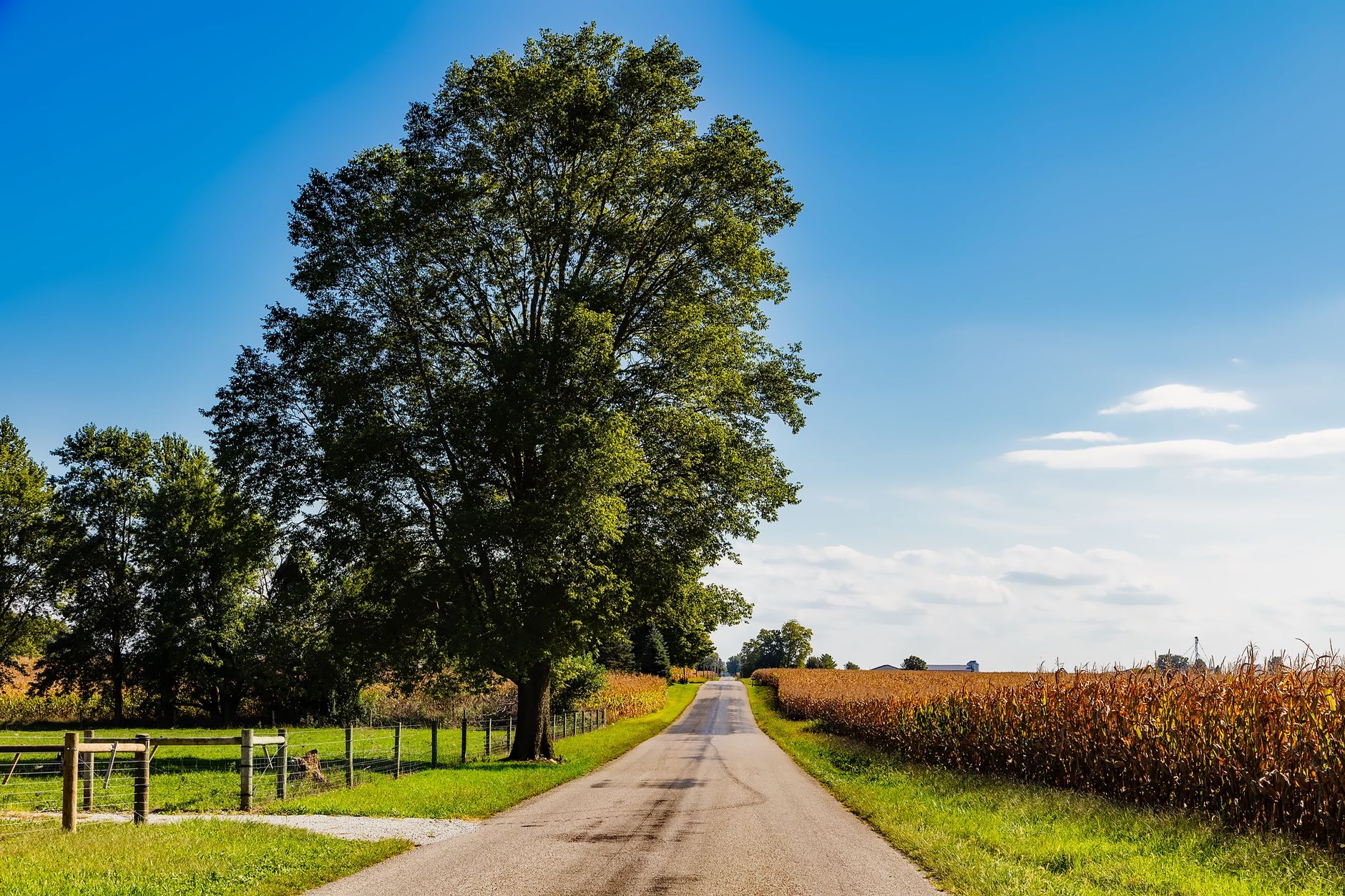
Indiana's roughly 92 counties span three distinct land markets — Chicago-adjacent farmland in the north, prime Indianapolis-ring cropland in the center, and hilly Ohio River-valley timber and recreational ground in the south. Deciding to sell land by owner in Indiana means understanding the state's specific disclosure form, deed filing rules, and county-by-county closing costs — all covered below, along with where a cash buyer like PlaceAcre fits in as an alternative to listing.
The good news for Indiana sellers is that the mechanics are unusually clean. There is no state transfer tax to calculate, no mandatory attorney at the closing table, and no statutory attorney-review window to schedule around. What Indiana does require is a specific piece of paper — the Sales Disclosure Form — and a specific sequence: your county assessor stamps both that form and your deed before the county recorder will file anything. Miss that step and your closing stalls at the courthouse counter.
The harder part is pricing, because Indiana acreage does not trade at one number. A tiled, flat forty in Hamilton County and a wooded forty in Brown County are both "Indiana land," and they can be separated by five figures per acre. This guide walks the whole process in the order you'll actually hit it: price, documents, marketing, closing — then the tactical detail, the legal citations, and the regional value picture underneath it all.
Indiana Cropland Climbed Another 4.8% in 2025
Indiana cropland values rose 4.8% in 2025 alone, part of a broader run-up that has taken the state's farm real estate average from roughly $9,100 per acre in 2023 (USDA NASS) toward the front of the Corn Belt pack — well above the record $4,350 per acre national average USDA reported for 2025.
For a seller, that context matters in two ways. It sets a defensible floor under your asking price on good row-crop ground, and it tells you that the buyers most likely to pay full value are the operators already farming nearby — the people watching those same numbers.
Read the full breakdown: Farmland Hits Record Prices →
Realtor vs. FSBO vs. Cash Buyer (PlaceAcre)
Illustrated on a sample 40-acre Indiana parcel valued at $150,000. Every figure below is an illustrative example, not a quoted offer.
| Realtor (MLS) | FSBO | Cash Buyer (PlaceAcre) | |
|---|---|---|---|
| Commission / fees | ~6% (~$9,000) | $0 commission | $0 fees or commissions |
| Typical time to close | 60–90 days | 90–180 days (thinner buyer pool for land vs. homes) | 7–14 days |
| Estimated net | ~$141,000 (before other closing costs) | ~$147,000 after modest marketing costs (~$500–$1,000) | Offer typically below full retail market value in exchange for speed and certainty |
| What you deal with | Listing agreement, showings, agent coordination | All marketing, inquiries, and paperwork yourself | No repairs, no showings, no financing contingencies |
All figures above are illustrative examples, not quoted offers or appraisals. Actual net proceeds vary by parcel, county fees, buyer financing, and negotiated terms.
The 4-Step FSBO Roadmap for Indiana Land
Step 1 — Price
Start with your county assessor's office. Indiana assessment records are parcel-level and public, and every county maintains sales data you can pull for free — acreage, parcel number, assessed value, and the classification of the ground. Look specifically for comparable land sales within the last twenty-four months and within a few miles, and note whether each was tillable row crop, pasture, or wooded.
Then cross-reference against Purdue University's Center for Commercial Agriculture farmland value survey. It is the closest thing Indiana has to a statewide, land-grant-backed benchmark, and it breaks values out by productivity tier and region rather than lumping the whole state into one average. Indiana buyers know that survey. Pricing against it — rather than against a number you liked — puts you on the same footing in a negotiation.
One caution: Indiana assesses qualifying farmland using a statutory base rate tied to agricultural use, not to market value. Your assessed figure keeps the tax bill manageable, but it can sit far below what the parcel would actually bring — especially in the Indianapolis ring, where development interest has pulled market prices well away from agricultural value. Use the assessment for facts, not for price.
Step 2 — Documents
Indiana law (IC 32-21-5) requires a completed Seller's Residential Real Estate Sales Disclosure Form (State Form 46021) disclosing your current actual knowledge of the property's condition. The standard is exactly that — what you actually know. You are not required to commission an independent inspection or investigate conditions you have no knowledge of. What you cannot do is stay quiet about something you do know: a drainage problem, a failed septic, an access issue, a boundary that doesn't match the fence.
Exemptions exist for several common situations, including transfers through probate or court order, foreclosure sales, and transfers to a spouse, a co-owner, or a close family member. Inherited ground moving through an estate frequently qualifies. Confirm your specific situation with your title company rather than assuming — the cost of guessing wrong is a disclosure claim after closing.
Alongside the form, gather the current deed, a recent property tax statement, any existing survey, the legal description, documentation of easements and access, mineral rights status, drainage tile information if it exists, and any farm lease currently in place with its termination terms. A buyer planning to plant next spring needs to know whether a tenant already has the right to.
Step 3 — Market
List on LandWatch, Land.com, and Facebook Marketplace. Those three cover the serious land-buyer traffic and the regional casual traffic respectively, and none of them require an agent. Write the listing around the facts a land buyer actually screens on: total acres versus tillable acres, road frontage, access, soil productivity, drainage, and lease status.
Post through your county's Farm Bureau classifieds as well. In rural Indiana counties that channel still carries genuine weight, and it reaches exactly the audience that pays the most for farm ground — the operator two roads over who can add your acreage to an existing rotation without buying another piece of equipment.
And do not skip the obvious: a simple roadside "For Sale by Owner" sign still works well on rural Indiana routes. County-road traffic is local traffic, and local traffic is your buyer pool. Put a phone number on it big enough to read at 45 miles an hour.
Step 4 — Close
Indiana closings are customarily handled by a title company. An attorney is not required by law, though it is worth retaining one if your sale involves probate, liens, delinquent taxes, or any question about who holds title. The title company will run the search, issue the commitment, prepare or review the deed, and disburse funds.
The Indiana-specific sequence to plan around: both the Sales Disclosure Form and the deed must be stamped by the county assessor's office before the county recorder will file them. That is an extra courthouse stop, and it is the step that most often surprises a first-time FSBO seller. Your title company normally handles it, but confirm who is doing it before closing day rather than after.
From accepted offer to recorded deed, a clean Indiana cash closing commonly runs two to four weeks; a financed sale typically stretches to 45 days or more while the lender orders an appraisal on rural acreage. Title defects, heirship gaps on inherited ground, unreleased mortgages, and survey disputes are the usual delays — all cheaper to find before you list than after you're under contract.
FSBO in Indiana: Advantages vs. Challenges
Advantages
- You keep the full sale price minus your own costs — no commission comes off the top at closing.
- You control your own timeline and showings, including whether to wait out a neighboring operator's bid or close before year-end for tax reasons.
- No listing-agreement lock-in, so you're never contractually stuck with a broker who isn't producing.
Challenges
- A smaller buyer pool than a home sale — far fewer people are shopping for raw acreage at any given moment.
- You handle all the disclosure paperwork yourself, including State Form 46021 and the assessor-stamping sequence.
- Land sits longer on market without MLS and agent-network exposure.
- Financing-contingency buyers can fall through late, after you've been off the market for weeks.
What the Commission Actually Costs You
Run the arithmetic on that same $150,000 Indiana land sale. A 6% listing commission runs $9,000. On a 40-acre tract, that's roughly two and a half acres of your ground handed over at the closing table for marketing and coordination work.
Selling by owner keeps that $9,000 in your pocket, minus modest marketing costs — call it $500 to $1,000 for photography, drone work, and listing fees. That's a net savings of roughly $8,000 to $8,500 in this example.
That doesn't make an agent the wrong choice in every case. A farm broker with an active buyer list for Central Indiana cropland may produce a higher gross price than you can reach alone, and on top-tier ground that premium can exceed the fee. The honest test is whether the price lift beats the commission. On straightforward tracts with clean title, obvious access, and an interested neighbor, it frequently doesn't.
The Tactical Version: 5 More Steps
Get a land-specific appraisal
Rural acreage appraisals typically run $300–$600, compared with $500 and up for a full residential appraisal — land is simpler to appraise because there are no structures or mechanical systems to evaluate. The value isn't the number itself so much as having something defensible to point at when a buyer challenges your price. Ranges are illustrative and vary by county, acreage, and complexity.
Order or confirm your legal survey
If your boundaries aren't already clearly marked, get a survey before you list. Indiana farm ground routinely produces the same three surprises: fence lines that don't match the deed, road right-of-way that eats into usable acres, and drainage easements nobody remembers granting. Finding those before you price is far better than renegotiating during due diligence.
Build a marketing packet
Include acreage (total and tillable), soil type and productivity index if available — pull it free from the USDA Web Soil Survey, because Indiana buyers will look it up whether you provide it or not — mineral rights status, and any easements. Add the tax statement, the legal description, and current lease terms. A packet that answers the obvious questions gets fewer calls and much better ones.
Screen buyers before granting property access
Ask for proof of funds on cash offers and a lender pre-approval letter on financed ones, before anyone walks the ground. Rural land financing is materially harder than home financing — many banks want 25–30% down on bare acreage — and a buyer who hasn't spoken with an ag lender is a buyer whose deal has a real chance of dying in month three.
Schedule closing with a title company
Bring your signed, notarized deed and the completed Sales Disclosure Form. Confirm in advance who is walking both documents through the county assessor for stamping ahead of recording, and ask the title company for a preliminary net sheet so you know your actual take-home number before you sit down at the table.
Indiana Legal Requirements and County Fees
Sales Disclosure Form — IC 32-21-5
IC 32-21-5 establishes the Sales Disclosure Form requirement. State Form 46021 asks for your current actual knowledge of the property's condition; no independent inspection is required. The statutory exemptions cover probate and court-ordered transfers, foreclosure sales, and transfers to a spouse, co-owner, or close family member, among others.
Conveyance procedures — Indiana Code Title 32, Article 21
Indiana Code Title 32, Article 21 governs conveyance procedures generally — how interests in real property are transferred, executed, and recorded. It's the statutory backbone behind the deed requirements, notarization, and recording sequence your title company will follow.
Deed types
A general warranty deed is standard for arm's-length Indiana sales — it gives the buyer the broadest title covenants, and it's what a title company and a lender will both expect. A quitclaim deed is common for family transfers and estate cleanups, but a retail buyer will generally resist accepting one because it conveys only whatever interest you happen to hold, with no warranty behind it.
No state transfer tax — but county fees apply
Indiana has no state real estate transfer tax, which is a real advantage over most neighboring states. County-level recording and transfer fees vary instead — for example, Marion County charges roughly $2 per $1,000 of sale price and Lake County roughly $3 per $1,000. Confirm the exact current fee with your county recorder, since these are set locally.
Assessor stamping before recording
Both the deed and the Sales Disclosure Form must be stamped by the county assessor before the county recorder will record them. This is the procedural step most likely to trip up a self-managed closing. Build it into your timeline and confirm who is responsible for it.
This is general information, not legal or tax advice. Confirm current statutes and county fee schedules with an Indiana attorney, title company, or your county recorder before closing.
Regional Land Values Across Indiana
Northern Indiana (Lake, Porter, St. Joseph counties)
Chicago-exurb pressure layered on top of a solid corn and soybean base. Prime cropland near development corridors runs roughly $9,000–$11,000+ per acre. Here, zoning designation, municipal annexation boundaries, and utility proximity can matter as much as soil — a parcel's value may hinge on a planning decision rather than a harvest.
Central Indiana / Indianapolis Ring (Hamilton, Hendricks, Boone, Johnson counties)
Among the state's highest per-acre values — high-$8,000s to low-$12,000s per acre for flat, tiled cropland. Two buyer types compete for the same ground: farm operators expanding a footprint, and developers pricing against Indianapolis's outward growth. That competition is why assessed agricultural value and actual market value diverge most sharply in this region.
East-Central Indiana (Whitewater Valley and surrounding corn/soy counties)
Solid mid-tier Corn Belt ground, roughly $7,000–$8,500 per acre. Less development pressure than the Indianapolis ring means pricing here tracks productivity closely — soil index, drainage tile condition, and field layout drive the number, and the neighboring operator is usually your best buyer.
Southern Indiana (Brown, Harrison, Perry counties — Ohio River valley)
Hillier terrain with hardwood timber and pasture rather than row crop, and correspondingly lower per-acre averages of roughly $3,000–$5,000 per acre. Demand is steady from hunting and recreational buyers, and the value drivers change completely: deer and turkey quality, water features, timber stand value, cabin-buildable ground, and road access.
All per-acre ranges above are estimated, based on 2023 USDA county-level data plus the 2025 statewide 4.8% cropland increase, since a full 2025 county-by-county breakout was not available at time of writing. They are not appraisals, and variance inside every region is wide.
Photographing and Marketing Indiana Land
Drone aerial shots showing full parcel boundaries — along with any water features and road frontage — outperform ground-level photos for raw land, and on flat Indiana cropland that gap is especially wide. A ground-level photo of a corn row tells a buyer nothing. An aerial tells them shape, access, field layout, waterways, and how the tract sits relative to the road, all in one frame.
Shoot in late spring or early fall, when crops or foliage best show the land's character. Late spring gives you green, established stands and full timber canopy; early fall gives you the golden standing-crop look that reads as productive ground. Bare dirt in March is honest but unflattering, and a snow-covered field in January tells a buyer almost nothing about what they'd be buying.
Include a simple boundary overlay in your listing photos — hand-drawn is acceptable, GIS-pulled from your county's parcel viewer is better. Mark boundaries, road frontage, waterways, tile mains if you know them, and any building site. Then write the practical facts into the copy: tillable versus total acres, soil productivity index, lease status, drainage, and mineral rights.
Skip the Hassle — Get a Cash Offer on Your Indiana Land
A cash sale is one option among several, and it isn't right for everyone. The offer reflects an as-is, no-repair, fast-close purchase, so it sits below what a patient retail sale might eventually produce. But if you'd rather not spend three to six months marketing rural acreage, screening financed buyers, and waiting on lender appraisals, it's worth having a real number to compare your other options against. No commission, no agents, and a closing measured in days rather than months.
Get Your Cash Offer TodayFrequently Asked Questions
Do I need a real estate agent to sell land in Indiana?
No. Indiana law does not require a licensed real estate agent or an attorney for a private land sale. You can price, market, negotiate, and contract on your own, and close through a title company. Professional help is still worth paying for in specific situations — a probate or estate sale, a parcel with liens or delinquent taxes, unclear or heirship title, or a boundary dispute with a neighbor. In those cases a few hundred to a couple thousand dollars of attorney time is cheap insurance against a deal that unwinds after closing.
What disclosure form do I need to sell land in Indiana?
The Seller's Residential Real Estate Sales Disclosure Form — State Form 46021, required under IC 32-21-5. It asks you to disclose your current actual knowledge of the property's condition; it does not require you to hire an inspector or investigate anything you don't already know. Exemptions exist for several common situations, including transfers through probate or a court order, foreclosure sales, and transfers to a spouse, a co-owner, or a close family member. Confirm with your title company whether your specific sale qualifies before you skip the form.
Is there a real estate transfer tax in Indiana?
No. Indiana has no state-level real estate transfer tax, which is a genuine cost advantage over neighboring states. Counties do charge their own recording and transfer-related fees, and those vary — for example, roughly $2 per $1,000 of sale price in Marion County and $3 per $1,000 in Lake County. Confirm the exact current fee schedule with your county recorder before closing, because these are set locally and change.
How long does it take to sell land by owner in Indiana?
Plan on 90 to 180 days for a typical FSBO land sale. The buyer pool for raw acreage is thinner than for houses, rural land financing takes longer to arrange, and a financed buyer can still fall through late. A cash-buyer sale is the fast alternative — often 7 to 14 days, because there is no lender, no appraisal contingency, and no repair negotiation. The trade-off is price: a cash offer sits below full retail in exchange for speed and certainty.
Related Resources
Related Locations in Indiana
Indiana county-level pages are still in progress. In the meantime, the state hub covers all 92 counties.