
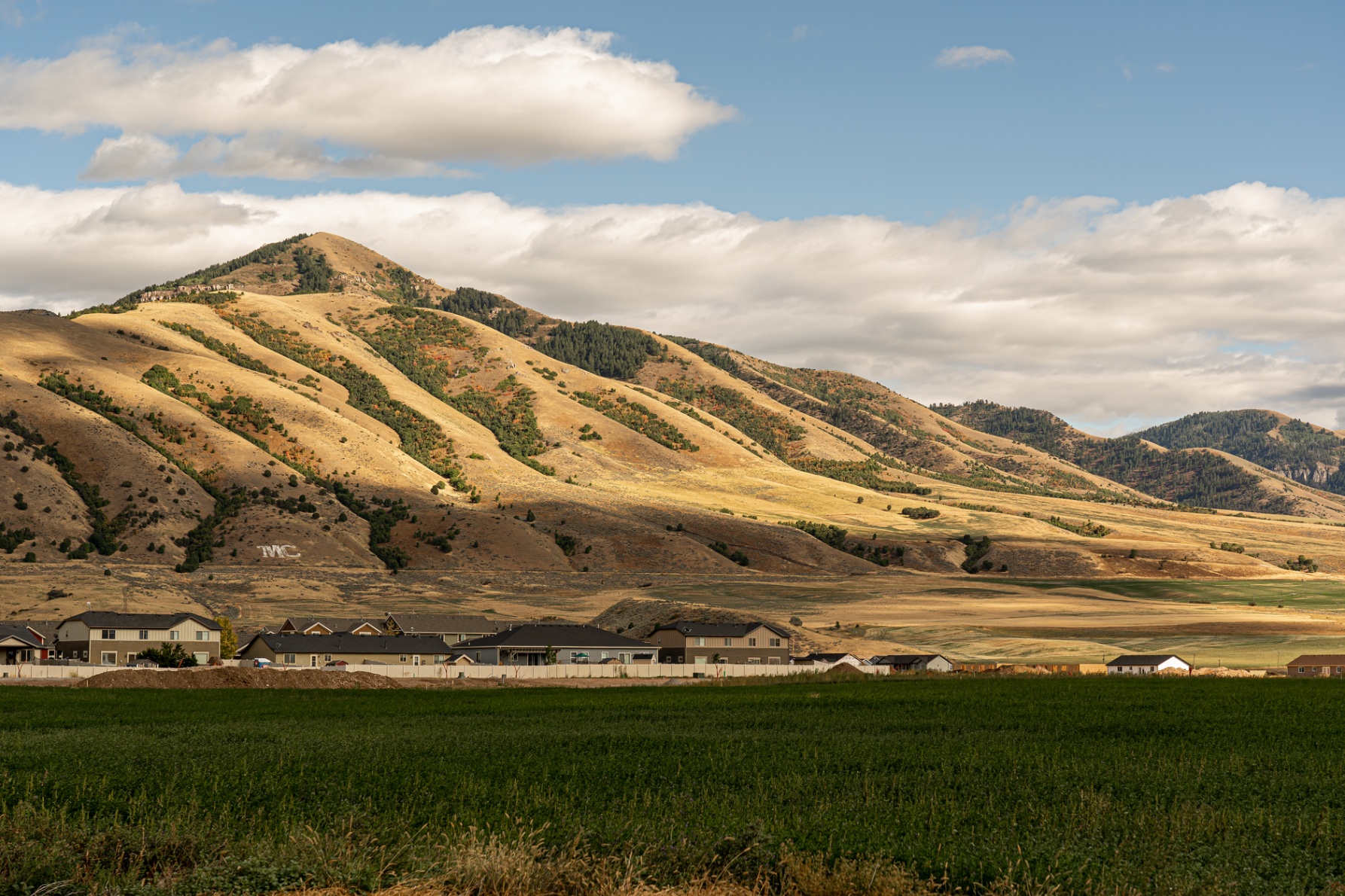
Utah's land market runs across two very different worlds — fast-growing Wasatch Front suburbs pushing into the foothills, and high-desert rangeland stretching across the Uintah Basin and the state's southern corners. If you want to sell land by owner in Utah, the first job is figuring out which of those markets your parcel actually sits in, because the pricing math, the buyer pool, and even the paperwork emphasis change accordingly.
This guide walks you through pricing, disclosure obligations, marketing, and closing an FSBO land sale in Utah, plus a side-by-side comparison against listing with a realtor or selling to a cash buyer. All dollar figures below are illustrative examples drawn from Utah land-marketplace listings and statewide averages — not appraisals of any specific parcel.
Drought and wildfire are squeezing Utah's ag landowners right now
Utah is in the middle of a rough stretch for producers. USDA designated 13 Utah counties as natural disaster areas earlier in 2026, and on July 17, 2026 USDA's NRCS announced $500,000 in emergency EQIP funding for Utah producers hit by wildfires — applications due July 31, 2026. That's on top of the existing Livestock Forage Disaster Program covering drought-related grazing losses.
For owners of Utah rangeland or agricultural acreage, that backdrop is pushing some sellers toward a faster sale rather than riding out another dry year. Read how the 2026 drought is reshaping ranch and pastureland decisions nationwide →
Realtor vs. FSBO vs. Cash Buyer
Illustrated on a sample 40-acre parcel priced at $126,000 (40 acres × roughly $3,150/acre — the illustrative statewide average for raw/agricultural Utah land). Your regional multiplier will shift these numbers dramatically — Wasatch Front growth land trades much higher, southern Utah desert typically much lower — but the structure of the comparison holds.
| Realtor (MLS) | FSBO | Cash Buyer (PlaceAcre) | |
|---|---|---|---|
| List / offer price | $126,000 | $126,000 | Typically below full retail, priced for speed & certainty |
| Commission & fees | ~6% (~$7,560) | $0 commission; you handle marketing & negotiation | $0 commission, $0 fees |
| Time to close | 6–12 months for rural land | 4–9 months | As few as 7–14 days |
| Est. net proceeds | ~$115,000 minus holding & closing costs | ~$120,000 minus your marketing/closing costs and time | Full offer paid at closing, no marketing or holding costs |
All dollar figures above are illustrative examples based on Utah's statewide average land value — not an appraisal of any specific parcel.
The 4-Step FSBO Roadmap for Utah Land
Step 1 — Price your land
Utah's per-acre values span more than an order of magnitude between regions (see the Regional Land Values section below), so a statewide average by itself is rarely a useful pricing anchor. Start by pulling recent listings and sold data for parcels of comparable size, access, and zoning within your own county.
Then cross-check against your county assessor's parcel record — for example the Salt Lake County Assessor, Utah County Assessor, or Washington County Assessor. Assessed value often trails market value (sometimes by a lot in fast-appreciating Wasatch Front submarkets), but it's a useful lower-bound benchmark and it confirms basic facts about your parcel that buyers will check anyway — acreage, tax status, and current classification.
Step 2 — Get your documents in order
Utah's statutory seller-disclosure requirement is unusually narrow: Utah Code § 57-27-201 requires disclosure of known methamphetamine contamination on the property. That's the main affirmative statutory line — but it is not the whole story.
Under Utah common law (per Utah Supreme Court precedent), sellers still have a duty to disclose known material defects that a reasonable inspection wouldn't discover. On top of that, state law requires disclosing known easements and — critical in Utah — exactly what water shares or water rights (if any) are included in the sale. Water is often owned and conveyed separately from land in Utah, so buyers and title companies will expect this stated plainly in the purchase agreement.
Also pull your current deed and confirm the legal description at the county recorder's office; any recorded easements, restrictions, or rights-of-way should be surfaced now, not after a buyer's title search flags them.
Step 3 — Market the parcel
Utah has a few marketing lanes that consistently work for FSBO land: MLS flat-fee listing services (which get your parcel into the syndicated feeds without a full listing agreement), the specialized land marketplaces — LandWatch, Land.com, and Zillow's land listings — and local classifieds.
Utah has one classifieds site worth naming specifically: KSL Classifieds. It's the dominant local marketplace across the state and a common first stop for in-state buyers looking at rural or building lots. For rangeland or ag ground, layer in state cattlemen's association channels and farmer/rancher Facebook groups; those tighter networks often surface a serious buyer faster than the big marketplaces do.
Step 4 — Close the sale
Utah closings are typically handled by a title company or escrow company — an attorney is not required, unlike some East Coast states. The title company runs the search, prepares closing docs, holds escrow, and coordinates recording.
After signing, the deed is recorded at the county recorder's office in the county where the parcel sits. Recording is what makes the transfer public, protects the buyer's interest, and — practically — is when the last of your closing responsibilities as the seller ends.
Per-acre figures above are illustrative statewide averages, not specific to any parcel.
FSBO in Utah — Advantages vs. Challenges
Advantages
- • No listing commission — you keep what would have been ~6% to an agent
- • Full control over price and timeline
- • Direct buyer relationships, which matter in tight-knit rural Utah markets
- • Flexibility to structure a water-rights carve-out or easement retention yourself
Challenges
- • Smaller buyer pool for land than for homes
- • Harder to price without solid comps, especially on unusual parcels
- • Marketing takes longer for rural or vacant parcels
- • Buyer financing for raw land is harder to arrange than for a house
Worked example: commission savings on a $126,000 parcel
On the sample $126,000 40-acre Utah parcel used above, a standard 6% realtor commission would run $7,560 — money an FSBO seller or a direct cash-sale seller keeps. Some of that will get spent back on flat-fee MLS listing, drone photography, or a paid appraisal; the rest stays in your net proceeds. Illustrative math on an illustrative parcel — your own numbers will scale up or down based on region.
Expanded Step-by-Step: 5 More Tactical Moves
1. Get a professional appraisal (or at minimum a broker price opinion)
A professional rural-land appraisal in Utah typically runs $400–$800, more for large or complex parcels. For a standard building lot or a small ag parcel with plenty of comps, comps and county assessor data may be enough. For anything unusual — a mixed-use ranch with grazing plus water rights, a Wasatch Front infill parcel with unclear zoning, or a Uintah Basin section with an oil-and-gas history — pay for the appraisal. You'll recover it in the first serious negotiation.
2. Pull your deed and confirm the legal description at the recorder
Before you list, go to the county recorder's office and pull your recorded deed. Confirm the legal description matches how you'll describe the parcel to buyers, and note any recorded easements (utility, access, irrigation, conservation) that will follow the land. Buyers' title work will surface these anyway — surfacing them yourself first keeps you from renegotiating price mid-escrow when a surprise easement turns up.
3. Photograph the parcel in different seasons and light
One-time photo shoots undersell Utah land. A parcel that looks brown and empty in August looks completely different green in May or dusted in October snow. Try to build a small photo library across at least two seasons, and consider a drone shot for anything over 5 acres — an aerial that shows boundaries, road access, and surrounding context does more selling work than any ground-level photo.
4. List on at least 2–3 platforms
Don't rely on a single listing site. A typical Utah FSBO listing plays best when it's on the MLS (via a flat-fee listing service), on one of the land-specific marketplaces (Land.com / LandWatch), and on KSL Classifieds for local reach. Three lanes, three different buyer audiences, one parcel.
5. Vet buyers for proof of funds before granting access
Especially for remote parcels — anything an hour or more from a metro area — always ask for proof of funds (bank statement, lender pre-approval, or 1031 exchange documentation) before you drive out for a showing or hand over gate codes. It cuts the tire-kicker rate significantly, and it filters out the fringe of buyers who won't be able to actually close.
Utah Legal Requirements
Statutory disclosure. Utah Code § 57-27-201 requires disclosure of known methamphetamine contamination on the property. That's Utah's main affirmative statutory disclosure line for real property.
Common-law disclosure duty. Beyond the statute, Utah common law (per Utah Supreme Court precedent) requires sellers to disclose known material defects that a reasonable inspection wouldn't discover. State law also requires disclosing known easements and — critically for Utah — exactly what water shares or water rights are (or aren't) being conveyed with the land.
Transfer tax. Utah has no state-level real estate transfer tax, which simplifies the closing math relative to a lot of other states.
Typical closing costs. Expect title insurance (varies by policy amount, commonly 0.5–1% of sale price), recording fees at the county recorder (typically under $100), and prorated property taxes to the closing date. The title/escrow company will produce a settlement statement listing each line item before signing.
Attorneys. Not required. Utah is a title-company/escrow-closing state — add an attorney only if you have complex title, boundary, or water-rights issues you want counsel on.
Regional Land Values in Utah
All ranges below are 2026 estimates drawn from Utah land-marketplace listings and regional land-value reporting — not appraisals. Every parcel is its own market of one; treat these as directional context, not price targets.
Wasatch Front (Salt Lake, Utah, Davis, Weber counties)
Highest demand in the state. Developable land near growth corridors often trades $15,000–$45,000+/acre, driven by Utah's fast population growth and constrained buildable supply between the lake and the mountains.
Central Utah (Sanpete, Sevier, Juab counties)
Farmland typically $2,000–$10,000/acre, rural home sites in the $10,000–$50,000/acre band depending on utilities and access, and undeveloped land $1,000–$5,000/acre.
Southern Utah desert (Washington, Iron, Kane counties)
Roughly $500–$5,000/acre, with growing recreational and retirement-driven demand — especially around the St. George corridor, which continues to pull population and second-home buyers from out of state.
Uintah Basin / Eastern Utah
Rangeland typically $1,000–$5,000/acre. The legacy oil and gas economy shapes local demand, and mineral rights history is a common negotiation point on larger parcels.
Marketing & Photography Tips
Buyers underwrite Utah land from the listing before they ever drive out. A few habits pay off across every region:
- Shoot in early morning or late afternoon light. Utah landscapes photograph dramatically better in golden hour than at noon.
- Show water features and road access. If the parcel touches a creek, canal, or reservoir, or if it fronts a paved road, put those images at the top of the gallery.
- Include the mountain view. Where relevant, show what a buyer sees standing on the land — the Wasatch backdrop, the Uintas, the red-rock horizon in the south. That's often what sells the parcel emotionally.
- Disclose any access easement or landlocked status upfront. Utah has plenty of parcels reached only by a recorded easement or by permission across a neighbor. Saying so in the first paragraph of the listing filters wasted inquiries and preserves seller credibility.
Skip the Hassle — Get a Cash Offer for Your Utah Land
One option among several. No commissions, no marketing wait, no back-and-forth with financed buyers. Tell us about your Utah parcel and we'll come back with a no-obligation cash offer.
Frequently Asked Questions
How long does it take to sell land by owner in Utah?
FSBO rural land sales in Utah typically take 4–9 months depending on region and price point; a cash sale can close in 7–14 days.
Do I need a real estate attorney to sell land in Utah?
No — Utah is a title-company/escrow-closing state, so an attorney isn't required, though sellers with complex title issues may want one.
What do I need to disclose when selling Utah land?
Known material defects, any known easements, and specifically what water shares or water rights (if any) are included in the sale.
Is my land worth more as agricultural or developable acreage?
It depends on zoning, water rights, and proximity to growth corridors like the Wasatch Front. A local assessor record or appraisal is the most reliable starting point.
Related Resources
Related Locations in Utah
More Utah-specific location pages are coming soon.