
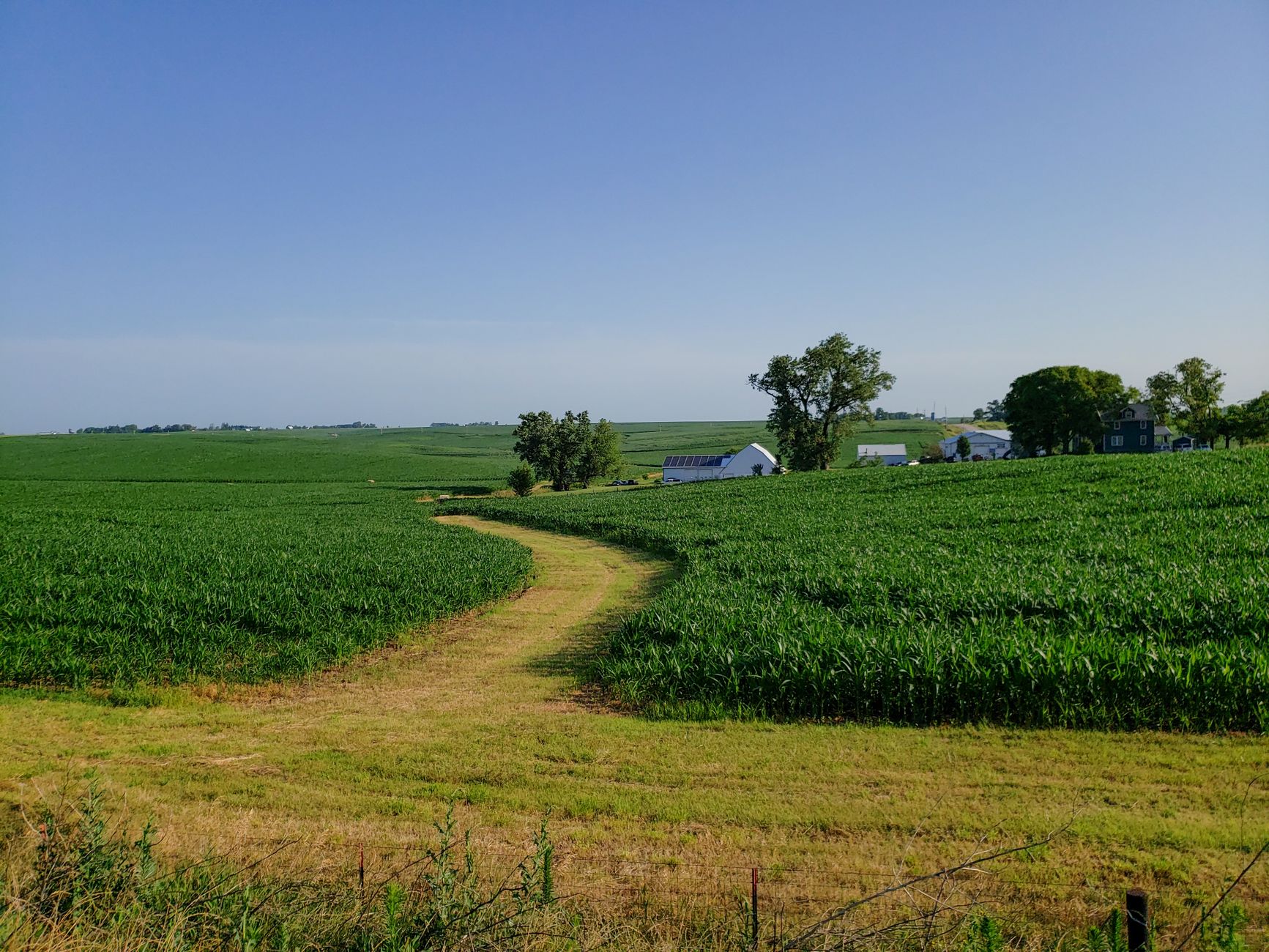
Iowa farmland just set a new high-water mark in USDA's 2026 numbers, and that changes the math on how you go to market this year. If you're weighing whether to sell land by owner in Iowa or hand the job to a farm broker, the first thing worth knowing is that your ground is being valued against a benchmark most of your likely buyers already follow closely — which means a well-priced FSBO listing starts on much firmer footing here than in most states.
Iowa is unusual among farm states in how transparent its land market is. Between the county assessor's public sales records, Iowa State University's annual survey, and the steady drumbeat of public farmland auctions, a seller can build a defensible price without hiring anyone. The paperwork side is equally well-defined — Iowa Code Chapter 558A governs the disclosure statement, Iowa Code 558.69 governs the groundwater hazard filing, and the transfer tax is a fixed formula rather than a negotiation.
What follows is the whole process in the order you'll actually encounter it: price, documents, marketing, closing — then the tactical detail, the legal citations, the regional value picture, and an honest comparison of what a listing agent, an FSBO sale, and a cash buyer each cost you. Selling to a cash buyer is one option among several here, not the recommendation.
Iowa Cropland at $10,700/Acre — and Two Numbers Worth Knowing
USDA's Land Values Summary, released July 31, 2026, put Iowa cropland at $10,700 per acre, up 3.9% year over year — the highest individual cropland value in the Corn Belt. Nationally, cropland crossed $6,000 an acre for the first time in the same report.
Iowa State University's own 2025 Land Value Survey reports a statewide farmland average of $11,549 per acre, up 0.7%, and still $286 per acre below the 2023 peak of $11,835.
The two figures differ because USDA NASS surveys nationally with a different sampling methodology than ISU's Iowa-specific survey, and because they measure slightly different property mixes. Don't try to reconcile them into one number — cite both. A buyer who knows the market will respect a seller who understands why the gap exists.
Read the full breakdown: Cropland Cracks $6,000 an Acre for the First Time →
Realtor vs. FSBO vs. Cash Buyer (PlaceAcre)
Illustrated on a sample 80-acre Iowa parcel at $11,549/acre — roughly $923,920 total. Every figure below is an illustrative example, not a quoted offer.
| Realtor (MLS) | FSBO | Cash Buyer (PlaceAcre) | |
|---|---|---|---|
| Commission / fees | ~6% commission (~$55,435) | 0% commission, but your own time is the cost | 0% commission, no fees |
| Typical time to close | 9–18 months | 6–12 months | 14–30 days |
| Estimated net proceeds | ~$868,485, minus marketing and any repair or cleanup costs | ~$923,920, minus your own marketing and closing costs | Negotiated below full market value in exchange for speed and certainty |
| What you deal with | Listing agreement, showings, broker coordination | All marketing, buyer screening, disclosures, and paperwork | No showings, no financing contingency, no lease-timing scramble |
All figures above are illustrative examples, not quoted offers or appraisals. An actual PlaceAcre offer depends on the specific parcel — soils, access, tenancy, title, and location.
The 4-Step FSBO Roadmap for Iowa Land
Step 1 — Price
Start with your county assessor's office. All 99 Iowa counties publish parcel-level records, and most now have searchable online sales data. Pull comparable sales from the last twenty-four months within a few miles of your ground, and record for each one whether it was tillable row crop, pasture, timber, or a mixed tract with buildings. Price per acre only means something once you know what kind of acre sold.
Then cross-reference the ISU Land Value Survey, published each December by Iowa State University Extension and the Center for Agricultural and Rural Development. It's free, it's regionally broken out, and it's the number Iowa farm buyers, lenders, and brokers all cite. Pricing against a public benchmark rather than a figure you'd like to get puts you and your buyer on the same page from the first conversation.
Then adjust for your specific ground. The single biggest lever in Iowa is CSR2 — the Corn Suitability Rating 2 index, which scores soil productivity on a scale topping out around 100. Iowa buyers price off CSR2 almost reflexively, and a tract in the 80s trades on different terms than one in the 50s even on the same county road. Regional variation matters just as much; see the regional breakdown further down this page before you settle on a number.
Step 2 — Documents
Iowa Code Chapter 558A requires a written Real Estate Disclosure Statement for most transfers, covering the condition of the property as you actually know it. The standard is your current actual knowledge — you're not required to hire an inspector or investigate conditions you're unaware of. You are required not to stay quiet about what you do know: a drainage failure, a contested boundary, an access problem, a well that's gone bad.
Iowa Code 558.69 is the one that trips up FSBO sellers. Before a county recorder accepts your deed, you must file a Groundwater Hazard Statement — or the deed itself must carry the specific statutory exemption language confirming there are no wells, private burial sites, solid waste disposal sites, underground storage tanks, hazardous waste, or private sewage disposal systems on the property. There is no third path. Settle which route you're taking with your closing agent early, not on closing day.
Alongside those two, gather the current deed, a recent tax statement, any existing survey, the full legal description, FSA farm and tract numbers, documented easements and access, drainage tile maps and drainage-district information, CSR2 data, mineral rights status, and any cash-rent or crop-share lease with its termination terms. Iowa farm leases carry statutory termination timing — a buyer planning to plant next spring needs to know whether a tenant already holds that right.
Step 3 — Market
Iowa has a genuinely well-developed farmland marketing ecosystem, and most of it is open to sellers without an agent. Land.com and its sister sites carry the widest national land-buyer traffic. Farmers National Company and Peoples Company both maintain heavily-watched Iowa listing pages and auction calendars — even if you don't list with them, studying their comparable tracts is one of the best free pricing exercises available to you.
Locally, county Farm Bureau bulletins and county extension office postings still carry real weight in rural Iowa. That channel reaches precisely the audience that pays the most for farm ground: the operator two miles away who can fold your acres into an existing rotation without buying another combine. Neighbors are your highest bidders more often than not, and they're the cheapest audience to reach.
Don't neglect the low-tech options either. A roadside sign on a county blacktop reaches local traffic, and local traffic is your buyer pool. Iowa also has a strong public-auction culture — if your tract is competitive and clean, a well-publicized auction can outperform a private listing. That is a legitimate alternative to both FSBO and a brokerage listing, and it deserves consideration on its merits.
Step 4 — Close
Iowa does not require an attorney at closing, though many sellers choose to use one. Most transactions run through a title company or an independent closing agent, who will handle the title work, prepare or review the deed, coordinate the groundwater hazard filing, calculate the transfer tax, and disburse funds.
Iowa's title practice has a local wrinkle: abstracts of title and attorney title opinions are still common here, alongside or instead of commercial title insurance. If your buyer is financing through an ag lender, expect the abstract to be brought current and an attorney's opinion to be issued. That work takes time — start it as soon as you're under contract rather than two weeks before closing.
From accepted offer to recorded deed, a clean cash closing in Iowa commonly runs two to four weeks. A financed farmland purchase typically stretches to 45 days or more while the lender orders an appraisal on rural acreage. Heirship gaps on inherited ground, unreleased mortgages, drainage-district assessments, and survey discrepancies are the usual delays — all cheaper to resolve before you list than after you're under contract.
FSBO in Iowa: Advantages vs. Challenges
Advantages
- No commission. Nothing comes off the top at the closing table — on high-value Iowa ground that difference is measured in tens of thousands of dollars.
- Full control of timeline and terms. You decide whether to close before year-end for tax reasons, wait out a neighboring operator's bid, or time the sale around the crop year and an existing lease.
- Direct buyer relationships. In Iowa the best buyer is often someone you already know by name. Talking to them yourself, without a broker relaying messages, tends to produce a cleaner and faster negotiation.
Challenges
- Narrower marketing reach. An MLS-listed agent — and especially an established Iowa farm brokerage — has a buyer list you don't. On a competitive tract that reach can produce a higher gross price.
- Disclosure and paperwork fall entirely on you. Chapter 558A disclosures, the groundwater hazard statement, the declaration of value, lease terminations — all of it is your responsibility to get right.
- Negotiating without a professional buffer. When the buyer is a neighbor you'll still see at the co-op, having to counter their offer face to face is harder than most sellers expect.
What the Commission Actually Costs You
Run the arithmetic on that same sample tract: 80 acres at $11,549 per acre is $923,920. A 6% listing commission comes to $55,435 — roughly 4.8 acres of your own ground handed across the closing table for marketing and coordination.
An FSBO sale or a cash sale keeps that $55,435 in your pocket, less your own marketing costs — call it $1,500 to $4,000 for drone photography, a soils map package, listing fees, and printing. On a parcel this size, the savings dwarf the expense.
That doesn't make an agent the wrong choice in every case. An established Iowa farm broker with a standing buyer list for high-CSR2 ground can sometimes produce a gross price that beats what you'd reach alone by more than the fee — that's the honest test. On straightforward tracts with clean title, obvious access, and a neighbor already interested, the premium usually doesn't materialize. On a complex estate tract in a thin market, it often does.
The Tactical Version: 5 More Steps
5. Budget for an appraisal — and know when to skip it
Rural Iowa acreage appraisals typically run $400–$800, depending on tract size, complexity, and how far the appraiser has to travel. Ranges are illustrative and vary by county. The value isn't really the number; it's having something independent and defensible to point at when a buyer challenges your price. If you're selling to a neighbor at a price both of you already understand, you may not need one. If you're settling an estate among multiple heirs, you almost certainly do.
6. Build the Iowa marketing checklist
Professional drone photos showing field boundaries and access. Soil-productivity data with the CSR2 rating disclosed up front — Iowa buyers will look it up whether you publish it or not, so publishing it signals you have nothing to hide. A current plat map. Recent yield history if the ground is cash-rented or crop-shared. Tile and drainage records. FSA farm and tract numbers. A packet that answers the obvious questions generates fewer calls and much better ones.
7. Forget staging — photograph access instead
Staging is irrelevant for vacant land, but access is not. Photograph the road frontage from the road, the field entrance, the gate or approach, and any interior lane. Show the culvert. Show where a truck would turn around. A buyer's first unspoken question about any Iowa tract is how equipment gets on and off it, and photos answer that faster than a paragraph.
8. Prepare for due-diligence requests before they arrive
Serious Iowa buyers will ask for soil tests, tile and drainage records, drainage-district assessment history, lease terms and termination dates, and confirmation of any conservation program enrollment such as CRP. Have that folder assembled before you list. A seller who produces documents within a day of the request keeps deal momentum; a seller who takes three weeks invites a renegotiation.
9. Negotiate and review the purchase agreement carefully
Get proof of funds on cash offers and an ag-lender pre-approval on financed ones before granting property access. When the agreement comes together, pay close attention to the closing date relative to the crop year, who receives the current year's rent, how growing crops are handled, tax proration, and which party pays the transfer tax and recording fees. Iowa doesn't require an attorney here — but this is the document most worth having one read.
Iowa Legal Requirements and Closing Costs
Two statutes do most of the work in an Iowa land sale, and both are worth reading rather than skimming.
Iowa Code Chapter 558A — Real Estate Disclosures
Requires a written Real Estate Disclosure Statement for most transfers, delivered to the buyer before the contract becomes binding. The disclosure is based on your current actual knowledge of the property's condition. Certain transfers — including some court-ordered, estate, and related-party transactions — fall outside the requirement. Confirm your specific situation with your closing agent rather than assuming an exemption applies.
Iowa Code 558.69 — Groundwater Hazard Statement
Required before a county recorder will accept the deed, unless the deed carries the specific exemption language confirming that the property contains no wells, private burial sites, solid waste disposal sites, underground storage tanks, hazardous waste, or private sewage disposal systems. Most rural Iowa parcels have at least one of those conditions somewhere in their history, so plan on filing the statement rather than relying on the exemption.
Transfer Tax and Closing Costs
Iowa's real estate transfer tax is $0.80 per $500 of declared value, with the first $500 exempt, and it is customarily paid by the seller. On our $923,920 sample tract that works out to roughly $1,478. It's a real cost, but a predictable one — you can calculate it exactly before you ever sign.
- Transfer tax — $0.80 per $500 of declared value, first $500 exempt; customarily the seller's expense.
- County recording fees — set locally, modest, and payable when the deed and groundwater hazard statement are filed.
- Owner's title insurance or abstract/attorney opinion — optional but common; Iowa's abstract-and-opinion practice means costs vary more here than in most states.
- Prorated property taxes — negotiated between the parties; Iowa's tax payment schedule runs in arrears, which makes proration worth confirming line by line on the settlement statement.
- Declaration of value — filed with the transfer, and the basis on which the transfer tax is calculated.
This section is general information, not legal or tax advice. Confirm current requirements with your county recorder, closing agent, or an Iowa attorney.
Iowa Land Values by Region
The statewide average is a starting point, not a price. Iowa's four broad sub-regions trade nearly two to one against each other, and where your ground sits matters as much as what's growing on it.
Northwest Iowa
$14,522/acreThe state's most productive row-crop soils and its strongest demand. Deep, high-CSR2 ground with an intensely competitive local operator base — livestock and ethanol demand keep bidding aggressive, and tracts here rarely sit long.
Central Iowa
Roughly $11,500–$12,500/acreThe corn and soybean heartland, tracking close to the statewide average. Proximity to the Des Moines metro adds a development-interest premium on some parcels near growing towns, which can pull a tract above its purely agricultural value.
Northeast Iowa
Mid-range valuesRolling terrain with a mix of dairy, livestock, and row crop. Slope and field shape create more within-county variation here than anywhere else in the state — two neighboring tracts can price quite differently based on how much of each is workable.
South Central Iowa
$7,823/acreThe state's most affordable farmland region. More pasture and timber, less continuous row crop, and thinner demand — though that same profile makes it Iowa's most active market for recreational, hunting, and small-acreage buyers.
Source: Iowa State University Center for Agricultural and Rural Development, 2025 Iowa Land Value Survey.
Photography and Listing Timing
Shoot from the air. A drone pass at 200 to 300 feet showing field boundaries, access roads, tile outlets, waterways, and neighboring land use communicates more in one frame than a page of description. Fly on a clear day with the sun low enough to show contour — mid-morning or the hour before sunset. Include at least one shot oriented north so a buyer can match it to a plat map.
Add a soil map overlay. Pull the soils layer from the USDA Web Soil Survey and overlay it on an aerial of the tract, with the CSR2 rating labeled. Iowa buyers evaluate ground this way instinctively, and handing them the analysis they were going to run anyway removes friction and signals confidence in the parcel.
Time the listing. Late winter through early spring, ahead of planting, is when Iowa farmland buyers are most actively shopping and when operators know what they can afford for the coming season. The post-harvest window in late fall is the second-best stretch. Listing in mid-July, with a crop in the ground and every operator busy, is the slowest thing you can do to your own timeline.
Skip the Hassle — Get a Cash Offer in 24 Hours
If speed and certainty matter more than squeezing out the last dollar, a cash sale closes in 14–30 days with no commission, no showings, and no financing contingency. It's one option among several — worth comparing against an FSBO listing, an auction, or a farm broker before you decide.
Get My Cash OfferFrequently Asked Questions
Do I need an attorney to sell land in Iowa?
No. Iowa does not require a licensed attorney to complete a private land sale, and most transactions close through a title company or an independent closing agent. That said, plenty of Iowa sellers hire one anyway, and for good reason: estates moving through probate, ground held by multiple heirs, parcels carrying unreleased mortgages or delinquent taxes, and splits that create a new legal description all benefit from a few hours of legal review. Iowa also has an unusual title convention — many transactions rely on an attorney's title opinion rather than a commercial title policy — so if your buyer's lender asks for one, an attorney is going to be involved regardless of who hires them.
What is a Groundwater Hazard Statement and do I need one?
It is a disclosure required under Iowa Code 558.69, and in most cases a county recorder will not accept your deed for filing without it. The statement asks whether the property contains wells, private burial sites, solid waste disposal sites, underground storage tanks, hazardous waste, or private sewage disposal systems. You can skip the separate form only if the deed itself carries the specific statutory exemption language confirming that none of those conditions exist on the parcel. Talk to your closing agent early about which route your sale is taking — this is the single most common reason a first-time FSBO closing gets bounced at the courthouse counter.
How long does it take to sell farmland by owner in Iowa?
Plan on six to twelve months for a typical FSBO farmland sale. Iowa's buyer pool for good row-crop ground is genuinely deep, but the calendar drives it: serious activity clusters in late winter before planting and again after harvest, and a lease already in place can push a closing to the end of the crop year. A cash sale is the fast alternative — commonly fourteen to thirty days, because there is no lender, no appraisal contingency, and no financing fall-through risk. The trade-off is price rather than paperwork.
What's the average price per acre for Iowa farmland in 2026?
Iowa State University's 2025 Land Value Survey puts the statewide farmland average at $11,549 per acre, up 0.7% year over year and still $286 per acre below the 2023 peak of $11,835. USDA's 2026 Land Values Summary, which uses a different national sampling methodology, pegs Iowa cropland specifically at $10,700 per acre, up 3.9%. Both are legitimate benchmarks measuring slightly different things. Regionally the spread is what matters most to a seller: roughly $7,800 per acre in South Central Iowa up to $14,500 and above in the northwest.
Related Resources
Related Locations in Iowa
Iowa county-level pages are still in progress. In the meantime, the state hub covers all 99 counties.