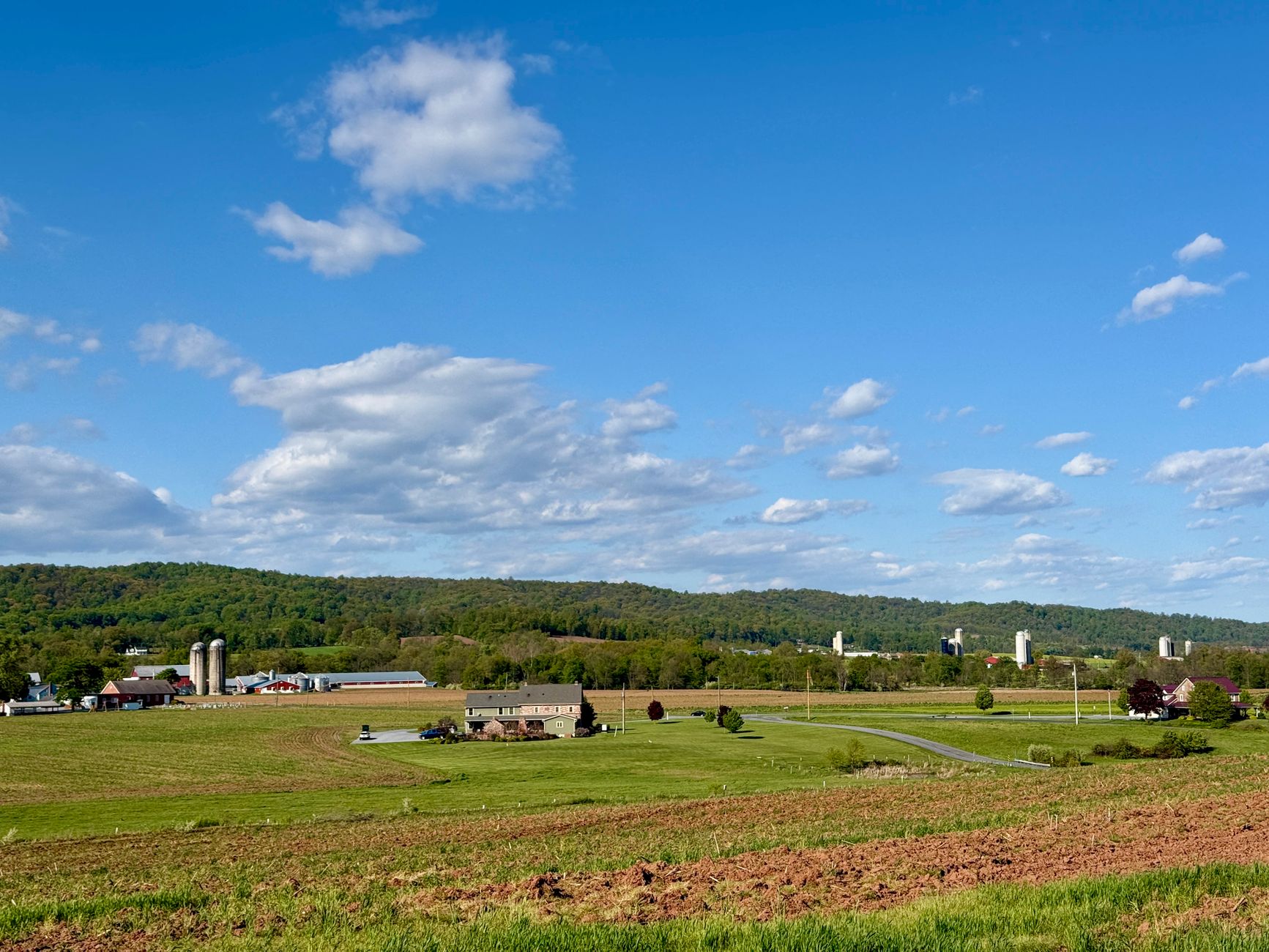
Choosing to sell land by owner in Pennsylvania is a very different exercise depending on where in the state your parcel sits. Pennsylvania has 67 counties and one of the most varied land markets in the Northeast: Lancaster County limestone-belt farmland trades among the most expensive agricultural ground in the country, the Pocono Mountains carry a steady recreational and second-home buyer pool, and the state's northern tier still has timber tracts and rural acreage priced closer to Appalachian averages than to the Mid-Atlantic ones.
This guide walks through pricing, disclosure obligations, marketing, and closing a Pennsylvania land sale without a realtor — with every meaningful number tied back to a source (USDA, PA Department of Revenue, county assessors, the Pennsylvania Consolidated Statutes) and anything estimated flagged as illustrative. Selling to a cash buyer is one option among several; the right path depends on your timeline, your net-proceeds target, and how much of the paperwork you want to run yourself.
The AI Data-Center Boom Is Quietly Rewriting Pennsylvania Land Values
In Salem Township (Luzerne County), 96 families collectively sold roughly 1,700 acres to QTS/Blackstone for a reported $586 million — an average of about $330,000/acre. Set that against USDA's 2025 statewide farm-real-estate average of $9,560/acre and you're looking at roughly a 35× premium for land that happened to sit on a hyperscale-ready power corridor.
Most Pennsylvania land isn't sitting on a hyperscale power corridor — but the Salem Township deal illustrates how fast values can move when infrastructure demand meets rural acreage. If your parcel is near an existing substation, a fiber trunk line, or a natural-gas pipeline, that context is worth surfacing before you price.
Read the Salem Township deal breakdownRealtor vs. FSBO vs. Cash Buyer: Pennsylvania Land Sale Comparison
Illustrated on a sample 20-acre Pennsylvania parcel valued at $150,000 (~$7,500/acre — a mid-range rural/vacant land estimate). Figures are illustrative on a hypothetical parcel, not guaranteed pricing.
| Realtor (MLS) | FSBO | Cash Buyer (PlaceAcre) | |
|---|---|---|---|
| Commission | ~6% (~$9,000) | $0 | $0 |
| Typical time to close | 60–180+ days | 60–180+ days (seller runs marketing, showings, negotiation) | 7–21 days |
| Net proceeds (illustrative) | ~$141,000 minus closing costs | ~$150,000 minus closing costs and any marketing spend | Close to offer amount; no commission, no marketing spend, PlaceAcre pays standard closing costs |
The Pennsylvania FSBO Roadmap: Price → Documents → Market → Close
1. Price
Start with your county assessor. Offices like the Lancaster County Assessment Office, the Monroe County Assessment Office, and the assessor in whichever of the state's 67 counties your parcel sits in publish parcel records, assessed values, and (in most counties) recent sales you can pull without hiring anyone. Get the last 12–24 months of sales for parcels similar in acreage, zoning, and use.
A wrinkle unique to Pennsylvania: assessed values do not equal fair market value. Pennsylvania uses a Common Level Ratio (CLR) published annually by the PA State Tax Equalization Board (through the Department of Revenue) that varies county by county. To convert assessed value to fair market value — the number transfer tax is calculated on — you divide the assessed value by the county's current CLR factor. Pull your county's current CLR before you price; some counties last reassessed decades ago, and the CLR can move the implied market value by a multiple.
Cross-check assessor data against active listings on Land.com, LandWatch, and the Lands of America network, and — if your parcel is agricultural — against USDA NASS county-level cash-rent and land-value releases. USDA's 2025 average of $9,560/acre is a reasonable statewide anchor for farm real estate; it will be too high in the Northern Tier and too low in Lancaster County.
2. Documents
Pennsylvania's Real Estate Seller Disclosure Law (68 Pa.C.S. §§7301-7315) requires sellers to disclose known material defects. Important nuance: the statute is written primarily around improved residential (1-4 unit) property, and its direct application to raw or vacant land is narrower. That doesn't mean you disclose nothing.
For unimproved land, the safe practice is to disclose in writing any known environmental issues (contamination, old septic, buried tanks, junkyard history), easements (utility, access, conservation), mineral- or oil-and-gas rights severances, and access limitations (landlocked, private-road maintenance obligations, right-of-way disputes). If you're unsure whether a specific item is required, run it past a Pennsylvania real estate attorney — this is a nuance, not settled legal advice. Buyers of Pennsylvania land routinely walk from deals where disclosures surface late; delivering the packet upfront is both cheaper and faster.
3. Market
Without MLS access you'll lean on land-specific marketplaces (Land.com, Lands of America, LandWatch), regional Facebook groups organized by county or township, and local classifieds. In and around Lancaster, Chester, and Berks counties, the Plain-community (Amish and Mennonite) buyer networks handle a meaningful share of private farmland transactions off the public market. Word-of-mouth through a local auctioneer, a neighboring farmer, or a Plain-community neighbor can move ground faster than a national portal.
Whichever channels you use, build the packet before you list: parcel map, current tax record, CLR-adjusted market value, zoning summary, any easements or rights-of-way, and 8–15 quality photos (including drone shots if the parcel is over five acres). Under-marketed land listings sit for a year; well-packaged ones sell.
4. Close
Pennsylvania closings follow different regional customs. In the Philadelphia area, closings commonly involve attorneys by convention — many buyers and sellers expect it, and some settlement companies work directly under attorney supervision. In Pittsburgh and western Pennsylvania, closings are more title-company-driven, with attorneys used more selectively for anything complex.
The standard statewide contract is the Pennsylvania Association of Realtors (PAR) Standard Agreement for the Sale of Real Estate. FSBO sellers can't use the PAR form directly (it's licensed to realtors), but an attorney-drafted equivalent covering the same points — price, contingencies, disclosures, transfer-tax allocation, closing date, deed type — will serve. Your title company or attorney prepares the deed, runs the title search, coordinates the settlement statement, and records with the county Recorder of Deeds.
FSBO in Pennsylvania: Advantages vs. Challenges
Advantages
- No 6% listing commission — on a $150,000 parcel that's $9,000 kept.
- Full control over timeline, pricing changes, and showings.
- Direct buyer relationships — especially valuable in Plain-community farm areas where transactions are often relationship-driven.
- No dual-agency or listing-agreement lock-ins to unwind if you change strategy mid-sale.
Challenges
- Running the county-specific assessment ÷ CLR math correctly, and defending the resulting price to skeptical buyers.
- Marketing rural acreage that MLS-focused buyers won't otherwise see.
- Handling showings on remote, unimproved parcels — often with no cell service and no obvious access point.
- Coordinating perc tests, surveys, or well-suitability studies yourself if a buyer requests them.
Commission Savings: Worked Example
On a $150,000 Pennsylvania land sale, a standard 6% listing commission is $9,000. Selling FSBO — or to a cash buyer — keeps that $9,000 in your pocket. FSBO sellers should budget for marketing spend, potentially a survey ($800–$2,500), and attorney review ($500–$1,500) that a cash-buyer sale generally avoids; on a PlaceAcre offer, standard closing costs are paid by the buyer. The right choice comes down to whether you'd rather keep the $9,000 and do the work, or skip the work and accept a slightly lower net.
Five Tactical Steps Beyond the Basics
- Order an appraisal (or at minimum a CMA). Rural land appraisals in Pennsylvania typically run $400–$1,200, depending on region and how remote or difficult to access the parcel is. Timbered or steep tracts in the Alleghenies and Poconos sit higher; open cropland in the southeast sits lower. Money well spent on anything over $50,000.
- Build your marketing checklist. Professional photos and drone footage (especially for acreage), listings on Land.com / LandWatch / Lands of America, township and county Facebook groups, and — critically for rural PA — physical "For Sale by Owner" road signage at the parcel and, if legal, at the nearest county road intersection. Local drive-by buyers close a meaningful share of rural PA land deals.
- Negotiate without an agent. Set a floor price (what you'll accept, not what you'll ask), collect all offers in writing, and require proof of funds or a lender pre-approval before you take the parcel off the market. Cash buyers in Pennsylvania are common on parcels under $250,000; ask for proof of funds even from them.
- Handle a survey if boundaries are unclear. Many Pennsylvania rural parcels — especially in the northern and central counties — have not been surveyed in decades. A boundary survey typically runs $800–$2,500 for standard rural acreage. If your parcel abuts a neighbor with a fence line that doesn't match the deed, order the survey before you list.
- Use a title company or real estate attorney for the deed and settlement statement. This is not optional. The title company (or attorney, in the Philadelphia region) runs the title search, confirms clear title, prepares the deed, calculates the transfer tax, prepares the settlement statement, and records the deed at the county Recorder of Deeds. Total cost typically $800–$2,500 depending on region and complexity.
Legal Requirements & Closing Costs
Pennsylvania's seller disclosure regime lives at 68 Pa.C.S. §§7301-7315 (the Real Estate Seller Disclosure Law), primarily oriented toward improved residential 1-4 unit property but with practical implications for any land seller who knows of a material issue. The Realty Transfer Tax lives at 72 P.S. §8102-C: 1% state, plus 1% local (split between the municipality and school district), for a 2% combined rate in most of the state. Custom splits this evenly between buyer and seller — 1% each — though the split is negotiable in the sales contract. Philadelphia and Pittsburgh add local rates that push the combined figure well above 2%; confirm your specific municipality's rate before you draft the contract.
Standard closing costs to budget for on a Pennsylvania land sale:
- Realty transfer tax: ~1% seller-side by custom (of the sale price, or of CLR-adjusted fair market value if that's higher).
- Title search & owner's title insurance: Pennsylvania is a state-regulated title-insurance state; premiums are set by the state and typically run ~0.5–0.9% of sale price. Custom on who pays varies regionally.
- Recording fees: typically under $100.
- Attorney fees (Philadelphia region especially): $500–$1,500 for a straightforward FSBO close.
- Prorated property taxes at closing.
Regional Land Values Across Pennsylvania
Southeastern PA / Lancaster County limestone belt
$12,000–$25,000+/acre for prime tillable farmland — the most expensive farmland in the state. Driven by the Plain-community buyer pool (Amish and Mennonite farm expansion), conservation-organization purchases (Lancaster Farmland Trust, Brandywine Conservancy, and others), and continuing residential development pressure from the Philadelphia and Baltimore-Washington corridors. Chester and Berks counties trail slightly but sit in the same tier.
Pocono Mountains / Northeast PA (Monroe, Pike, Wayne, Carbon)
Recreational and vacant residential lots more commonly land in the ~$8,000–$9,500/acre-equivalent range for smaller parcels, driven by New York and New Jersey second-home buyers. These figures reflect individual lot listings, not a formal regional index — flagged as illustrative. Larger raw-acreage tracts (20+ acres) generally trade below that per-acre level.
Northern Tier / North-Central PA (Tioga, Bradford, Susquehanna, Potter, Cameron)
Lower-cost timberland and rural acreage cited in county-by-county surveys as low as ~$1,500/acre. Flagged as illustrative — the range is very wide, and the number depends heavily on timber value, road access, oil and gas rights, and hunting-lease income potential. Marcellus Shale gas royalties and hunting-lease revenue can meaningfully change value on parcels where those rights are intact.
Statewide farm-real-estate average
$9,560/acre per USDA's 2025 Land Values Summary, up 3.1% from 2024. Useful as a directional anchor for agricultural ground; largely irrelevant for pure timber, recreational lots, or hyperscale-adjacent tracts.
Marketing & Photography Tips
- Fly a drone on anything over 5 acres — it's the only way to show buyers context and topography a phone camera can't. Pennsylvania's rolling terrain photographs badly from the ground.
- Mark your boundary corners visibly before photographing (surveyor's ribbon, temporary stakes) so drone footage shows what you're actually selling.
- Capture road frontage and any water features — creeks, springs, ponds, or wetland edges — in your primary shots. These are two of the biggest per-acre value drivers for PA buyers.
- Call out proximity to state game lands, state forests, or major trailheads (Loyalsock, Susquehannock, Michaux, the Pinchot). This is a strong buyer draw for recreational and hunting-parcel buyers in central and northern PA.
- Shoot at golden hour and skip the midday sun — flat midday light kills rolling-terrain photos.
Skip the Hassle — Get a Cash Offer on Your Pennsylvania Land
If you'd rather skip the marketing, showings, and closing-cost math, we'll make a no-obligation cash offer on your Pennsylvania parcel — typical close in 7–21 days, no commissions, standard closing costs paid.
Frequently Asked Questions
Do I have to disclose defects when selling vacant land in Pennsylvania?
Pennsylvania's Real Estate Seller Disclosure Law (68 Pa.C.S. §§7301-7315) is written primarily around improved residential (1-4 unit) property, so its direct application to raw or vacant land is narrower. Best practice is still to disclose known environmental issues, easements, mineral-rights severances, and access limitations in writing — and to confirm scope with a Pennsylvania real estate attorney if you're unsure.
How much is the Pennsylvania transfer tax on a land sale?
2% combined — 1% state plus 1% local — customarily split evenly between buyer and seller (1% each), though negotiable in the sales contract. Philadelphia and Pittsburgh have higher local rates.
How long does it take to sell land by owner in Pennsylvania?
Plan on 60–180+ days for a traditional FSBO sale. A cash-buyer close typically wraps in 7–21 days with no financing contingency.
What's my Pennsylvania land worth per acre?
USDA's 2025 statewide average is $9,560/acre for farm real estate — but the regional spread is enormous (Lancaster limestone belt $12,000–$25,000+/acre; Northern Tier timberland around $1,500/acre). See the regional values section above or use our land value calculator for a closer estimate.
Related Resources
Explore Pennsylvania Land
Ready to dig into Pennsylvania land data or get a cash offer on your parcel?
Visit the Pennsylvania land hub